West Virginia State Motto: Montani Semper Liberi
Montani Semper Liberi


Montani Semper Liberi
The motto appears on the state seal of West Virginia
- Motto
- Montani Semper Liberi
- Language
- Latin
- Translation
- Mountaineers Are Always Free
- Adopted
- 1863
West Virginia State Motto
West Virginia's state motto is Montani Semper Liberi, Latin for Mountaineers Are Always Free. The first state legislature adopted it on September 26, 1863, along with the Great Seal.
The motto was proposed by Joseph H. Diss Debar, the Alsatian-born artist who designed the state seal. Diss Debar lived among Swiss-German immigrants in Doddridge County, and the phrase expressed the independent spirit of mountain people — a fitting motto for a state born out of a refusal to follow Virginia into secession.
Translation of "Montani Semper Liberi"
The phrase is Latin. Montani means mountaineers or mountain people. Semper means always. Liberi means free. Together: Mountaineers Are Always Free.
The word liberi can also mean children in Latin, but in this context — combined with semper — the meaning is clearly free, not children. The phrase reads as a statement of permanent, unconditional freedom.
West Virginia State Motto Meaning
The motto connects directly to how West Virginia became a state. When Virginia voted to secede from the Union in 1861, the western counties — mountainous, less dependent on enslaved labor, economically tied to the North — refused to follow. They formed their own state government and joined the Union.
West Virginia became the 35th state on June 20, 1863, in the middle of the Civil War. The motto adopted three months later put that choice into words: mountain people choose freedom, and they always will.
History of West Virginia's State Motto
Joseph H. Diss Debar was born on March 6, 1820, in Strasbourg, Alsace (present-day France). He came to the United States in 1842 and settled in Parkersburg, West Virginia, in 1846. He later founded St. Clara, a Swiss-German immigrant colony in Doddridge County.
When West Virginia became a state in 1863, the legislature needed a seal and a motto. Diss Debar proposed the design and the Latin phrase Montani Semper Liberi. On September 26, 1863, the first West Virginia Legislature adopted both the motto and the Great Seal in the same session.
Diss Debar went on to represent Doddridge County in the House of Delegates in 1864 and served as the state's first Commissioner of Immigration. He died on January 13, 1905, in Philadelphia.
"Montani Semper Liberi" on the West Virginia State Seal
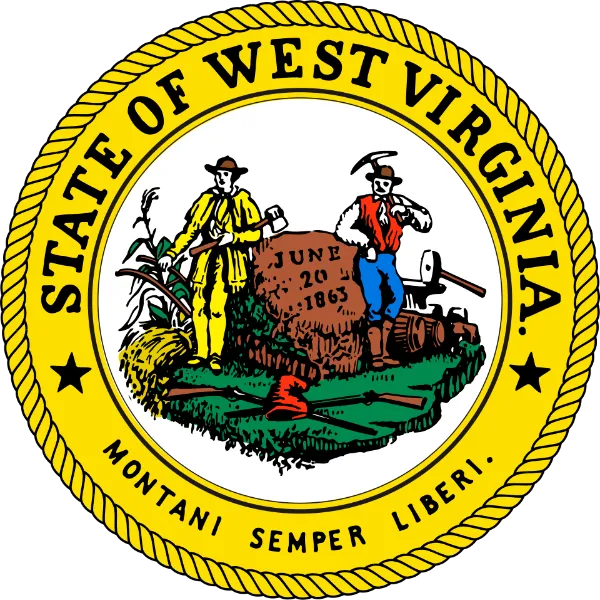
The motto appears on the Great Seal of West Virginia, also designed by Joseph H. Diss Debar in 1863. The central image shows a farmer and a miner standing on either side of a large boulder. The boulder is inscribed with the date June 20, 1863 — the day West Virginia became a state. Two crossed rifles and a liberty cap rest in front of it.
The seal appears on official state documents, the state flag, and government buildings. The state flag uses the same design: a white field with the Great Seal at the center, bordered by a blue band.
West Virginia State Motto Facts
- "Montani Semper Liberi" is Latin for "Mountaineers Are Always Free."
- The first West Virginia Legislature adopted the motto on September 26, 1863.
- West Virginia became a state just three months earlier, on June 20, 1863.
- The motto was proposed by Joseph H. Diss Debar, who also designed the Great Seal.
- Diss Debar was born in Strasbourg, Alsace, in 1820 and settled in West Virginia in 1846.
- The motto appears on the Great Seal, which shows a farmer, a miner, and a boulder inscribed with June 20, 1863.
Can You Match All 50 State Mottos?
Some questions show the original motto — Latin, Italian, Chinook — and ask which state it belongs to. Others give you the English translation and ask you to work backward. Both directions are harder than they look.
Take the State Mottos QuizQuick Answers
What is West Virginia's state motto?
What does "Montani Semper Liberi" mean?
What is the English translation of "Montani Semper Liberi"?
When did West Virginia adopt its state motto?
Who created West Virginia's state motto?
Sources
- West Virginia Public Broadcasting — September 26, 1863: First Legislature Adopts Motto and Seal
- WV Encyclopedia — Montani Semper Liberi
- WV Secretary of State — About the Seal
- WV Legislature — Official State Symbols
West Virginia State Symbols


Show more (2)


Related States


Compare all 50 states by population, land area, statehood date, and more.
Themed lists - states sharing the same bird, oldest symbols, flags with bears, and more.
Side-by-side comparison of population, area, income, taxes, climate, and more.
Top 20 most common surnames per state - with origins, meanings, and heritage context. Is yours on the list?
You Might Also Like

Serial Killers by State
Alaska has the highest serial killer rate at 0.867 per 100,000 residents. Hawaii is lowest, and California has the highest raw count at 128.

Flag of Arkansas
Arkansas had no state flag until 1913. Its white diamond marks the only diamond-producing state. A fourth star marks Confederate membership.

Flag of Arizona
Arizona's flag was sketched on an envelope in 1910 for a rifle team. Adopted in 1917, it became law without the governor's signature.

Flag of Alaska
Benny Benson designed Alaska's flag at 13. Eight gold stars on navy blue, the Big Dipper pointing to Polaris, adopted in 1927 and kept at statehood.

Alabama State Flag
Alabama's crimson cross on white was adopted in 1895, likely modeled after the Confederate Battle Flag. The state's first flag was destroyed by a storm one month after raising.

Flag of California
Brown grizzly on white, adopted in 1911, traces to settler William Todd's handmade flag raised at Sonoma on June 14, 1846.

Rainwater Harvesting Laws by State
Rainwater harvesting is legal in all 50 states. Colorado caps residential storage at 110 gallons, while Utah allows up to 2,500 gallons.

Weird Laws in Arkansas
Weird laws in Arkansas include a repealed statewide tattoo ban, a 145-year-old pronunciation law, and a Sunday car sales rule that is still enforced today.