Alabama State Flag
Alabama's crimson cross on white was adopted in 1895, likely modeled after the Confederate Battle Flag. The state's first flag was destroyed by a storm one month after raising.

Alabama State Flag
Official State Flag of Alabama
State Flag of Alabama
History of the Alabama State Flag

Montgomery women built Alabama's first flag for the January 11, 1861 secession vote. The silk banner showed the Goddess of Liberty, sword raised, with Independent Now and Forever across the top. On the reverse, a cotton plant and rattlesnake flanked the Latin warning Noli Me Tangere. A storm destroyed it within one month. It was retired to the governor's office, never flown again.
For three decades after, Alabama flew no official state banner, using the Confederate National Flag through the Civil War and the U.S. flag after. On February 16, 1895, the legislature passed Act 383, adopting the crimson diagonal cross on white that still flies today.
Little is recorded of the legislative debate beyond the final bill text. John W. A. Sanford Jr., a legislator from Montgomery County who introduced the bill, offered no floor explanation. The law named one color, set one minimum measurement, and stopped there. Mississippi adopted a Confederate-canton flag the same year.
Alabama's 1895 flag is one of the most legally sparse in the country. The law named one color, set one measurement, and gave no symbolism. What the cross was meant to say was left unwritten.
Alabama Flag Meaning and Symbolism
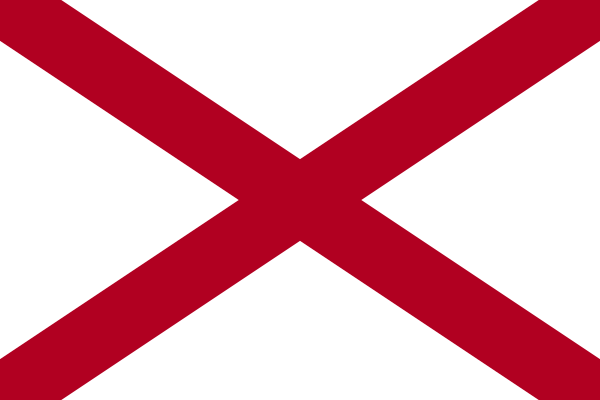

Saint Andrew's Cross

White Field
Official Colors and Dimensions
Alabama's flag uses crimson and white. No official shade of crimson has been defined in law, so reproductions range from deep rose to near-scarlet.
Confederate Flag or Spanish Cross?

Two theories explain the cross, and the historical record supports both. The first holds that Sanford designed it to mirror the Confederate Battle Flag through its square shape and diagonal cross. In 1905, the legislature considered adding stars to make the resemblance more direct. The proposal failed.
The second points to the Spanish Cross of Burgundy, a red diagonal cross on white that Spanish soldiers carried through the Southeast in the 1500s. Alabama's territory passed through Spanish, French, British, and Confederate control before statehood. In 1939, Alabama adopted a state coat of arms that incorporated the Confederate Battle Flag alongside the flags of France, Spain, and Britain.
Interesting Facts
Historical Versions of the Flag

← Drag or tap to compare →
An elaborate silk banner made by Montgomery women for the January 11, 1861 secession vote. It carried symbolic imagery on two sides and served as Alabama's only official state flag until the 1895 law.
Crimson saltire on white, adopted by Act 383 in 1895. The only flag Alabama has officially flown since.
All versions
Quick Answers
What does the Alabama state flag look like?
What does the cross on the Alabama flag mean?
Was the Alabama flag inspired by the Confederate flag?
What happened to Alabama's first flag?
Is the Alabama flag square or rectangular?
Sources
- Alabama Department of Archives and History
- Encyclopaedia Britannica — Alabama State Flag
- Encyclopedia of Alabama
Alabama State Symbols


Show more (2)


Related States


Compare all 50 states by population, land area, statehood date, and more.
Themed lists - states sharing the same bird, oldest symbols, flags with bears, and more.
Side-by-side comparison of population, area, income, taxes, climate, and more.
Top 20 most common surnames per state - with origins, meanings, and heritage context. Is yours on the list?
You Might Also Like

Serial Killers by State
Alaska has the highest serial killer rate at 0.867 per 100,000 residents. Hawaii is lowest, and California has the highest raw count at 128.

Flag of Arkansas
Arkansas had no state flag until 1913. Its white diamond marks the only diamond-producing state. A fourth star marks Confederate membership.

Flag of Arizona
Arizona's flag was sketched on an envelope in 1910 for a rifle team. Adopted in 1917, it became law without the governor's signature.

Flag of Alaska
Benny Benson designed Alaska's flag at 13. Eight gold stars on navy blue, the Big Dipper pointing to Polaris, adopted in 1927 and kept at statehood.

Alabama State Flag
Alabama's crimson cross on white was adopted in 1895, likely modeled after the Confederate Battle Flag. The state's first flag was destroyed by a storm one month after raising.

Flag of California
Brown grizzly on white, adopted in 1911, traces to settler William Todd's handmade flag raised at Sonoma on June 14, 1846.

Rainwater Harvesting Laws by State
Rainwater harvesting is legal in all 50 states. Colorado caps residential storage at 110 gallons, while Utah allows up to 2,500 gallons.

Weird Laws in Arkansas
Weird laws in Arkansas include a repealed statewide tattoo ban, a 145-year-old pronunciation law, and a Sunday car sales rule that is still enforced today.