Flag of Arizona
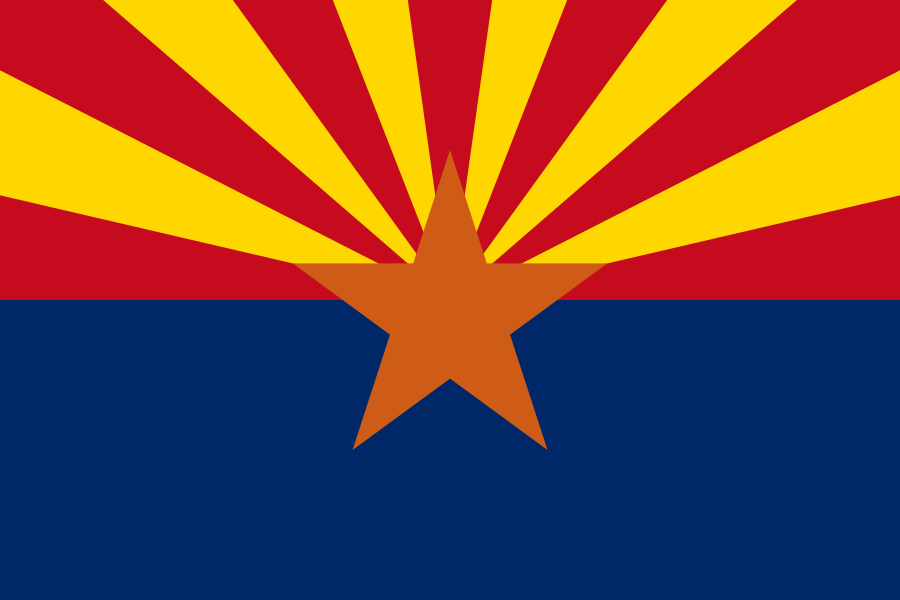
Arizona's flag was sketched on an envelope in 1910 for a rifle team. Adopted in 1917, it became law without the governor's signature.

Flag of Arizona
Official State Flag of Arizona
State Flag of Arizona
History of the Arizona State Flag

At the 1910 National Rifle Matches at Camp Perry, Ohio, every state team displayed a flag or emblem. Arizona had none. Colonel Charles W. Harris, serving as team captain, sketched a design of thirteen rays, a copper star, and a blue field. The rifle team carried it at national matches for seven years before the legislature took it up.
Carl Hayden, Arizona's first U.S. Representative, contributed to the design alongside Harris. When the legislature adopted the flag in 1917, the official version was sewn by Hayden's wife, Nan D. Hayden. On February 27, 1917, the Third Arizona Legislature passed the bill. Governor Thomas Campbell received it but never signed it. Under Arizona law, it passed without his signature. He never publicly explained why.
Arizona's flag began as a rifle team banner in 1910. Thirteen rays record the original colonies. A copper star names Arizona's largest industry. Red and gold honor the Spanish explorers who crossed the territory. Navy blue matches the U.S. flag.
Arizona Flag Meaning and Symbolism

Thirteen Rays

Copper Star

Blue Field
Official Colors and Dimensions
Arizona's flag uses blue, red, gold, and copper. Blue and red are matched to the U.S. flag by law, defined in state statute with Pantone and Cable values.
Interesting Facts
Historical Versions of the Flag


← Drag or tap to compare →
Harris's original design, used informally by the Arizona National Guard for seven years. No legislation gave it official status until 1917.
Harris's rifle team design formalized as the official state flag in 1917. It remains the only official flag Arizona has ever flown.
All versions
Quick Answers
Who designed the Arizona state flag?
What does the copper star on Arizona's flag mean?
Why does Arizona's flag have 13 rays?
Why are the rays red and gold?
Did Arizona's governor sign the flag into law?
Sources
Arizona State Symbols


Show more (2)


Related States


Compare all 50 states by population, land area, statehood date, and more.
Themed lists - states sharing the same bird, oldest symbols, flags with bears, and more.
Side-by-side comparison of population, area, income, taxes, climate, and more.
Top 20 most common surnames per state - with origins, meanings, and heritage context. Is yours on the list?
You Might Also Like

Serial Killers by State
Alaska has the highest serial killer rate at 0.867 per 100,000 residents. Hawaii is lowest, and California has the highest raw count at 128.

Flag of Arkansas
Arkansas had no state flag until 1913. Its white diamond marks the only diamond-producing state. A fourth star marks Confederate membership.

Flag of Arizona
Arizona's flag was sketched on an envelope in 1910 for a rifle team. Adopted in 1917, it became law without the governor's signature.

Flag of Alaska
Benny Benson designed Alaska's flag at 13. Eight gold stars on navy blue, the Big Dipper pointing to Polaris, adopted in 1927 and kept at statehood.

Alabama State Flag
Alabama's crimson cross on white was adopted in 1895, likely modeled after the Confederate Battle Flag. The state's first flag was destroyed by a storm one month after raising.

Flag of California
Brown grizzly on white, adopted in 1911, traces to settler William Todd's handmade flag raised at Sonoma on June 14, 1846.

Rainwater Harvesting Laws by State
Rainwater harvesting is legal in all 50 states. Colorado caps residential storage at 110 gallons, while Utah allows up to 2,500 gallons.

Weird Laws in Arkansas
Weird laws in Arkansas include a repealed statewide tattoo ban, a 145-year-old pronunciation law, and a Sunday car sales rule that is still enforced today.