South Carolina State Motto: Dum Spiro Spero
Dum Spiro Spero


Dum Spiro Spero
The motto appears on the state seal of South Carolina
- First motto
- Animis Opibusque Parati
- Translation
- Prepared in mind and resources
- Second motto
- Dum Spiro Spero
- Translation
- While I breathe, I hope
- Language
- Latin
- Adopted
- 1776
South Carolina State Mottos
South Carolina is one of the few U.S. states with two official Latin mottos. Both were adopted on April 2, 1776, as part of the state seal — months before the Declaration of Independence. Animis Opibusque Parati appears on the obverse of the seal above a palmetto tree. Dum Spiro Spero appears on the reverse above the figure of Spes, the Roman goddess of hope.
The two mottos were designed by two different people, each given one side of the seal. William Henry Drayton, a delegate to the Continental Congress, chose Animis Opibusque Parati for the obverse. Arthur Middleton, who later signed the Declaration of Independence, chose Dum Spiro Spero for the reverse.
South Carolina State Mottos Meaning
Animis Opibusque Parati translates from Latin as Prepared in mind and resources. William Henry Drayton selected it for the obverse in 1776 to assert that South Carolina entered the Revolution with both the will to fight and the material capacity to do so. The phrase paired with the seal's central image of a palmetto tree standing over a fallen oak, the visual record of the Battle of Fort Sullivan.
Dum Spiro Spero translates from Latin as While I breathe, I hope. The phrase is attributed to Cicero and had appeared in British heraldic traditions for generations before 1776, including as a personal motto inscribed by King Charles I during his imprisonment by Parliament in the 1640s. Arthur Middleton, who received a classical education in England, selected it for the reverse as a statement of perseverance under adversity.
The two mottos work as a pair. The obverse declares readiness; the reverse declares endurance. Together they describe what the 1776 General Assembly believed South Carolina would need: the capacity to fight, and the will to keep going.
Translation of Both Mottos
The standard English translation of Animis Opibusque Parati is Prepared in mind and resources. Some sources also render it as Prepared in minds and resources, since animis is an ablative plural. South Carolina's official sources use Prepared in mind and resources as the primary form.
The standard English translation of Dum Spiro Spero is While I breathe, I hope. The Latin is straightforward: dum means while, spiro means I breathe, and spero means I hope. No significant translation dispute exists for this phrase.
History of South Carolina's State Mottos
The South Carolina General Assembly authorized the state seal on April 2, 1776. Two members divided the design work: William Henry Drayton took the obverse, and Arthur Middleton took the reverse. Each designer chose his own motto and visual composition independently, which is why the two sides of the seal reflect different themes.
Drayton built the obverse around the Battle of Fort Sullivan, fought on June 28, 1776, almost three months after the seal's authorization. British warships attacked the incomplete fort on Sullivan's Island; its palmetto-log walls absorbed cannon fire rather than shattering, and the fleet withdrew. Drayton placed the palmetto above a fallen oak to record that outcome, and set Animis Opibusque Parati above it to claim that South Carolina had been ready.
Middleton designed the reverse around the figure of Spes walking over discarded British weapons at dawn, with Dum Spiro Spero on a ribbon above. A Charles Town engraver completed the original coin-silver seal, which President John Rutledge used officially for the first time on May 22, 1777. Both mottos have appeared on the seal continuously since.
Both Mottos on the South Carolina State Seal
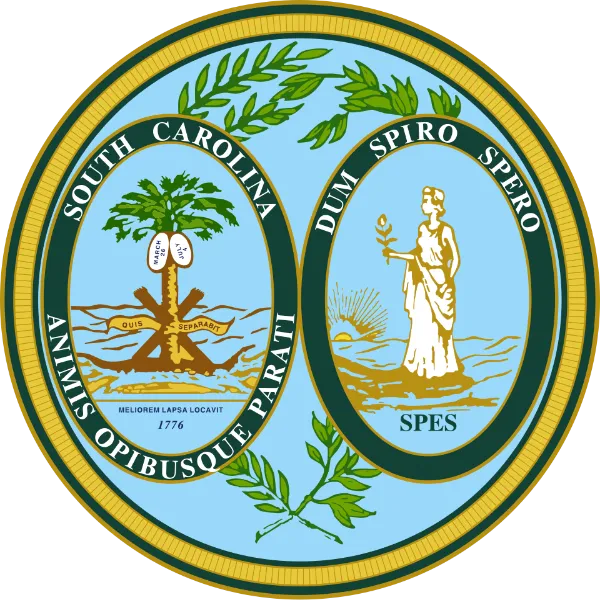
Animis Opibusque Parati appears on the obverse above a palmetto tree with a fallen oak at its base and twelve spears bound to the trunk. The twelve spears represent the twelve other colonies allied with South Carolina in 1776. The obverse is the primary face of the seal used for official authentication.
Dum Spiro Spero appears on the reverse above the goddess Spes, who walks along a beach at dawn holding a laurel branch, with discarded British weapons at her feet. The two elliptical vignettes are linked by palmetto branches on the full seal.
Both faces of the seal are used on official state documents, government buildings, and state letterhead. The seal is defined in South Carolina Code § 1-1-610.
South Carolina State Motto Facts
- South Carolina has two official state mottos, both in Latin.
- Both mottos were adopted on April 2, 1776 — months before the Declaration of Independence.
- "Animis Opibusque Parati" means "Prepared in mind and resources" and was chosen by William Henry Drayton.
- "Dum Spiro Spero" means "While I breathe, I hope" and was chosen by Arthur Middleton, who later signed the Declaration of Independence.
- "Dum Spiro Spero" is attributed to Cicero and was also used as a personal motto by King Charles I of England in the 1640s.
- The original state seal was a coin-silver disc, four inches in diameter, first used on May 22, 1777.
Can You Match All 50 State Mottos?
Some questions show the original motto — Latin, Italian, Chinook — and ask which state it belongs to. Others give you the English translation and ask you to work backward. Both directions are harder than they look.
Take the State Mottos QuizQuick Answers
What is South Carolina's state motto?
What does "Dum Spiro Spero" mean?
What does "Animis Opibusque Parati" mean?
What is the English translation of South Carolina's mottos?
When did South Carolina adopt its state mottos?
Sources
- South Carolina Code of Laws § 1-1-610
- South Carolina Encyclopedia — State Seal
- SCIway — State Seal and Motto
South Carolina State Symbols


Show more (2)


Related States


Compare all 50 states by population, land area, statehood date, and more.
Themed lists - states sharing the same bird, oldest symbols, flags with bears, and more.
Side-by-side comparison of population, area, income, taxes, climate, and more.
Top 20 most common surnames per state - with origins, meanings, and heritage context. Is yours on the list?
You Might Also Like

Serial Killers by State
Alaska has the highest serial killer rate at 0.867 per 100,000 residents. Hawaii is lowest, and California has the highest raw count at 128.

Flag of Arkansas
Arkansas had no state flag until 1913. Its white diamond marks the only diamond-producing state. A fourth star marks Confederate membership.

Flag of Arizona
Arizona's flag was sketched on an envelope in 1910 for a rifle team. Adopted in 1917, it became law without the governor's signature.

Flag of Alaska
Benny Benson designed Alaska's flag at 13. Eight gold stars on navy blue, the Big Dipper pointing to Polaris, adopted in 1927 and kept at statehood.

Alabama State Flag
Alabama's crimson cross on white was adopted in 1895, likely modeled after the Confederate Battle Flag. The state's first flag was destroyed by a storm one month after raising.

Flag of California
Brown grizzly on white, adopted in 1911, traces to settler William Todd's handmade flag raised at Sonoma on June 14, 1846.

Rainwater Harvesting Laws by State
Rainwater harvesting is legal in all 50 states. Colorado caps residential storage at 110 gallons, while Utah allows up to 2,500 gallons.

Weird Laws in Arkansas
Weird laws in Arkansas include a repealed statewide tattoo ban, a 145-year-old pronunciation law, and a Sunday car sales rule that is still enforced today.