Massachusetts State Motto: Ense Petit Placidam Sub Libertate Quietem
Ense Petit Placidam Sub Libertate Quietem


Ense Petit Placidam Sub Libertate Quietem
The motto appears on the state seal of Massachusetts
- Motto
- Ense Petit Placidam Sub Libertate Quietem
- Language
- Latin
- Translation
- By the Sword We Seek Peace, But Peace Only Under Liberty
- First used
- 1775 (Paul Revere)
- Formally adopted
- 1780
Massachusetts State Motto
Massachusetts's state motto is Ense Petit Placidam Sub Libertate Quietem, Latin for By the Sword We Seek Peace, But Peace Only Under Liberty. It was formally adopted in 1780, when Massachusetts ratified its own constitution — the oldest functioning written state constitution still in continuous use in the United States.
The phrase was not written for Massachusetts. It is attributed to Algernon Sidney, an English republican theorist who was beheaded in 1683 for arguing that political authority belongs to the people, not the monarch. Choosing his words for a colonial government arming itself against British rule was a deliberate act.
Massachusetts State Motto Meaning
The motto is built from six Latin words. Ense means by the sword. Petit means seeks. Placidam means peaceful or calm. Sub means under. Libertate means liberty. Quietem means rest, quiet, or peace. Taken together: Massachusetts seeks peaceful rest, but only under conditions of liberty — not under submission or conquest.
The motto does not celebrate war. It sets a condition: peace is the goal, but not peace at any price. Peace without liberty is not worth having. The sword is the means of last resort, drawn to protect freedom rather than to take it from others.
The armored arm holding a broadsword that appears above the shield on the state seal illustrates this directly. The sword is drawn, but the motto explains why: to reach peace, not to avoid it.
Translation of the Massachusetts Motto
The standard English translation is By the Sword We Seek Peace, But Peace Only Under Liberty. This is the version used by Massachusetts official sources.
A shorter version sometimes appears as By the Sword We Seek Peace, But Only Peace Under Liberty. The word order shifts slightly but the meaning does not change. The key phrase is the final condition: peace only under liberty, not peace under any circumstance.
History of Massachusetts's State Motto
Paul Revere designed the first Massachusetts seal in 1775 for the Massachusetts Provincial Congress, months before independence was declared. He incorporated the Latin phrase attributed to Algernon Sidney into the seal as a statement of Revolutionary purpose. Sidney had been beheaded in London in 1683 on charges of treason after writing that governments derive their authority from the consent of the governed, not from the divine right of kings.
Choosing Sidney's phrase was a pointed political act. A colonial government preparing to fight the British crown adopted a motto written by a man the British crown had killed for opposing it. The motto tied Massachusetts directly to a tradition of republican thought that predated the American Revolution by nearly a century.
When Massachusetts adopted its constitution in 1780, the seal — and with it the motto — was formally incorporated as the official emblem of the Commonwealth. Massachusetts used the term Commonwealth rather than State, a distinction preserved in the seal's border inscription Sigillum Reipublicae Massachusettensis, meaning Seal of the Commonwealth of Massachusetts.
In 2024, Massachusetts established the Seal, Flag, and Motto Advisory Commission to develop recommendations for possible new state symbols. The process reopened discussion about the seal's imagery and motto, but as of the time of publication the traditional seal and motto remain officially in effect under Massachusetts General Laws Chapter 2, Section 1.
"Ense Petit Placidam" on the Massachusetts State Seal
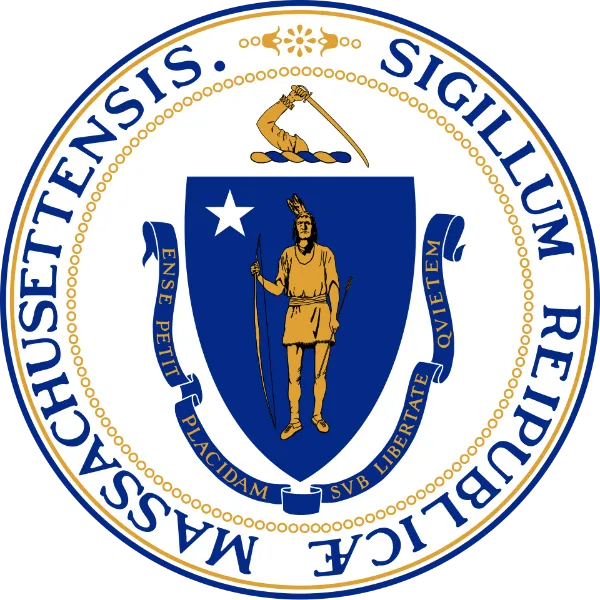
The motto circles the outer border of the Great Seal of Massachusetts, running around the central composition. The seal shows a Wampanoag figure on a blue shield, with an armored arm holding a broadsword above the shield and a five-pointed star to the right. The sword arm on the seal illustrates the motto directly: the blade is raised not to conquer, but to defend the condition the motto names.
Massachusetts's state flag shows the state seal on a white field, so the motto appears wherever the flag is displayed. Official state documents, government buildings, and the State House in Boston use the seal with the motto visible along the border.
Massachusetts State Motto Facts
- Massachusetts's state motto is "Ense Petit Placidam Sub Libertate Quietem" — Latin for "By the Sword We Seek Peace, But Peace Only Under Liberty."
- The phrase is attributed to Algernon Sidney (1623–1683), an English republican theorist executed by the British crown for arguing that political power belongs to the people.
- Paul Revere incorporated the motto into the Massachusetts seal in 1775, before independence was declared.
- The motto was formally adopted in 1780, when Massachusetts ratified the oldest functioning written state constitution still in continuous use.
- Massachusetts calls itself a Commonwealth, not a state — a distinction reflected in its seal's border inscription.
- Massachusetts ratified the U.S. Constitution on February 6, 1788, as the sixth state.
Can You Match All 50 State Mottos?
Some questions show the original motto — Latin, Italian, Chinook — and ask which state it belongs to. Others give you the English translation and ask you to work backward. Both directions are harder than they look.
Take the State Mottos QuizQuick Answers
What is the Massachusetts state motto?
What does the Massachusetts motto mean?
What is the English translation of the Massachusetts motto?
Who wrote the Massachusetts state motto?
When did Massachusetts adopt its state motto?
Massachusetts State Symbols


Show more (2)


Related States


Compare all 50 states by population, land area, statehood date, and more.
Themed lists - states sharing the same bird, oldest symbols, flags with bears, and more.
Side-by-side comparison of population, area, income, taxes, climate, and more.
Top 20 most common surnames per state - with origins, meanings, and heritage context. Is yours on the list?
You Might Also Like

Serial Killers by State
Alaska has the highest serial killer rate at 0.867 per 100,000 residents. Hawaii is lowest, and California has the highest raw count at 128.

Flag of Arkansas
Arkansas had no state flag until 1913. Its white diamond marks the only diamond-producing state. A fourth star marks Confederate membership.

Flag of Arizona
Arizona's flag was sketched on an envelope in 1910 for a rifle team. Adopted in 1917, it became law without the governor's signature.

Flag of Alaska
Benny Benson designed Alaska's flag at 13. Eight gold stars on navy blue, the Big Dipper pointing to Polaris, adopted in 1927 and kept at statehood.

Alabama State Flag
Alabama's crimson cross on white was adopted in 1895, likely modeled after the Confederate Battle Flag. The state's first flag was destroyed by a storm one month after raising.

Flag of California
Brown grizzly on white, adopted in 1911, traces to settler William Todd's handmade flag raised at Sonoma on June 14, 1846.

Rainwater Harvesting Laws by State
Rainwater harvesting is legal in all 50 states. Colorado caps residential storage at 110 gallons, while Utah allows up to 2,500 gallons.

Weird Laws in Arkansas
Weird laws in Arkansas include a repealed statewide tattoo ban, a 145-year-old pronunciation law, and a Sunday car sales rule that is still enforced today.