Maryland State Motto: Fatti Maschii, Parole Femine
Fatti Maschii, Parole Femine


Fatti Maschii, Parole Femine
The motto appears on the state seal of Maryland
- Motto
- Fatti Maschii, Parole Femine
- Language
- Italian
- Translation
- Manly Deeds, Womanly Words
- Charter year
- 1632
- Seal readopted
- 1876
Maryland State Motto
Maryland's state motto is Fatti Maschii, Parole Femine, an Italian phrase meaning Manly Deeds, Womanly Words. It is the only U.S. state motto written in Italian — every other state uses English, Latin, French, Spanish, Hawaiian, Greek, or a Native American language.
The phrase was not invented for Maryland. It was the personal motto of the Calvert family, the Lords Baltimore who founded the colony. When King Charles I granted Maryland's royal charter in 1632, the Calvert family's Italian motto came with it, and it has been part of Maryland's official identity ever since.
Maryland State Motto Meaning
The motto pairs two ideas: action and speech. Fatti maschii means manly deeds — things done, not just promised. Parole femine means womanly words — speech that is gentle, careful, or persuasive rather than aggressive. The phrase together describes an ideal of governance: act with strength, speak with care.
In 16th and 17th-century Italian culture, the contrast between fatti (deeds) and parole (words) was a common way to describe someone who delivers on their promises rather than just talking. The modifier maschii (manly) on deeds and femine (womanly) on words reflected the gendered language of Renaissance-era rhetoric, not a judgment about men and women specifically.
The phrase has attracted criticism in modern times because the literal translation assigns masculine qualities to action and feminine qualities to gentleness. The words mean something different in their 17th-century context than they do today, which has prompted discussion in Maryland about how the motto should be understood and translated.
Translation of "Fatti Maschii, Parole Femine"
The standard English translation is Manly Deeds, Womanly Words. This is the literal word-for-word version and appears in most official references.
Some sources and legislators have proposed Strong Deeds, Gentle Words as an alternative translation that captures the intent of the phrase without the gendered framing. In Italian, maschii and femine are adjectives that can describe qualities — strength and gentleness — rather than specifically referring to men and women. Both translations are linguistically defensible.
The official Italian text has not changed. The debate is about which English translation best represents the phrase for a modern audience.
History of Maryland's State Motto
The phrase Fatti Maschii, Parole Femine was the personal motto of the Calvert family long before Maryland existed. George Calvert, the 1st Baron Baltimore, petitioned King Charles I for a colonial charter in the New World. He died in April 1632 before the charter was formally issued. His son Cecil Calvert, the 2nd Baron Baltimore, received the grant and became Maryland's first proprietor.
Cecil Calvert brought the family's Italian motto with him into the colony's official design. The colonial seal carried the phrase on the reverse, paired with the Calvert and Crossland family arms — the same heraldry that appears on the Maryland state flag today. Using Italian for an aristocratic family motto was not unusual in Tudor and Stuart England; it reflected the influence of Renaissance culture on the English nobility.
Maryland's seal was set aside after the American Revolution. The heraldry of a British proprietary dynasty sat uncomfortably in a new republic, and Maryland used a different seal for several decades. In 1876, the Maryland General Assembly voted to restore the colonial Calvert design in full, including the Italian motto on the reverse. The seal in use today is continuous with that 1876 restoration.
"Fatti Maschii, Parole Femine" on the Maryland State Seal
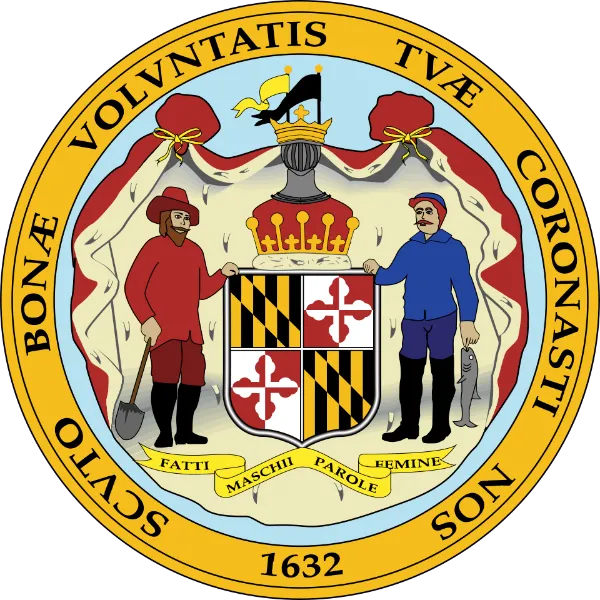
The motto appears on the reverse of the Great Seal of Maryland, on a ribbon at the base of the composition. The reverse shows the quartered Calvert and Crossland shield flanked by a farmer with a spade and a fisherman with a fish, with the date 1632 also present. The phrase appears in full capitals: FATTI MASCHII PAROLE FEMINE.
Maryland's Great Seal is the only U.S. state seal with two distinct sides. The obverse carries a separate, older motto: SCUTO BONAE VOLUNTATIS TUAE CORONASTI NOS, a Latin phrase from Psalm 5:12 meaning With the shield of thy good will thou hast covered us. That Latin motto was the Calvert family's religious motto. The Italian phrase on the reverse was their personal family motto. Both appear on the same official seal.
Maryland State Motto Facts
- Maryland is the only U.S. state with a motto in Italian.
- The phrase "Fatti Maschii, Parole Femine" was the personal motto of the Calvert family, who received Maryland's royal charter in 1632.
- Maryland's Great Seal is the only U.S. state seal with two distinct sides, each carrying a different family motto.
- The Italian motto appears on the reverse of the seal; a Latin motto from Psalm 5:12 appears on the obverse.
- The colonial Calvert seal design was set aside after the Revolution and formally restored by the Maryland General Assembly in 1876.
- The quartered Calvert and Crossland arms on the seal reverse are the same design as the Maryland state flag.
Can You Match All 50 State Mottos?
Some questions show the original motto — Latin, Italian, Chinook — and ask which state it belongs to. Others give you the English translation and ask you to work backward. Both directions are harder than they look.
Take the State Mottos QuizQuick Answers
What is Maryland's state motto?
What language is Maryland's state motto?
What does "Fatti Maschii, Parole Femine" mean?
What is the English translation of "Fatti Maschii, Parole Femine"?
Why does Maryland have an Italian motto?
Sources
Maryland State Symbols


Show more (2)


Related States


Compare all 50 states by population, land area, statehood date, and more.
Themed lists - states sharing the same bird, oldest symbols, flags with bears, and more.
Side-by-side comparison of population, area, income, taxes, climate, and more.
Top 20 most common surnames per state - with origins, meanings, and heritage context. Is yours on the list?
You Might Also Like

Serial Killers by State
Alaska has the highest serial killer rate at 0.867 per 100,000 residents. Hawaii is lowest, and California has the highest raw count at 128.

Flag of Arkansas
Arkansas had no state flag until 1913. Its white diamond marks the only diamond-producing state. A fourth star marks Confederate membership.

Flag of Arizona
Arizona's flag was sketched on an envelope in 1910 for a rifle team. Adopted in 1917, it became law without the governor's signature.

Flag of Alaska
Benny Benson designed Alaska's flag at 13. Eight gold stars on navy blue, the Big Dipper pointing to Polaris, adopted in 1927 and kept at statehood.

Alabama State Flag
Alabama's crimson cross on white was adopted in 1895, likely modeled after the Confederate Battle Flag. The state's first flag was destroyed by a storm one month after raising.

Flag of California
Brown grizzly on white, adopted in 1911, traces to settler William Todd's handmade flag raised at Sonoma on June 14, 1846.

Rainwater Harvesting Laws by State
Rainwater harvesting is legal in all 50 states. Colorado caps residential storage at 110 gallons, while Utah allows up to 2,500 gallons.

Weird Laws in Arkansas
Weird laws in Arkansas include a repealed statewide tattoo ban, a 145-year-old pronunciation law, and a Sunday car sales rule that is still enforced today.