Maine State Motto: Dirigo
Dirigo


Dirigo
The motto appears on the state seal of Maine
- Motto
- Dirigo
- Language
- Latin
- Translation
- I Lead
- Adopted
- 1820
Maine State Motto
Maine's state motto is Dirigo, a Latin word meaning I Lead. It has been part of the state seal since 1820, the year Maine separated from Massachusetts and joined the Union as the 23rd state.
The motto appears directly below the North Star on the seal — the star that sailors used to find true north. The two elements work together: the star that leads, and the word that claims it. Maine is sometimes called the Dirigo State because of the motto.
Maine State Motto Meaning
Dirigo is the first-person singular of the Latin verb dirigere, meaning to lead, to direct, or to guide. The translation I Lead is the standard English version used by Maine's official sources.
The word does two things on the seal at once. As a navigational claim, it refers to the North Star placed directly above it — the fixed point in the night sky that guided sailors to true north for centuries. As a political statement, it declared in 1820 that the newly independent state intended to lead, not follow, now that it had separated from Massachusetts.
Both meanings were relevant in 1820. Maine's economy depended on the sea: its ports shipped timber, its shipyards built vessels, and its fishermen worked the Atlantic. A motto tied to navigation fit the state's identity as a maritime territory. At the same time, the act of breaking from Massachusetts was itself a declaration of self-direction.
Translation of "Dirigo"
The standard English translation is I Lead. Some sources also translate it as I Direct or I Guide — all are accurate, since the Latin verb dirigere covers leading, directing, and guiding.
Maine's official sources use I Lead as the primary translation, and that is the version that appears most widely in state publications and educational materials.
History of Maine's State Motto
Maine had been part of Massachusetts since the colonial period. In 1820, Congress admitted Maine as the 23rd state on March 15 as part of the Missouri Compromise — Maine entered the Union as a free state to balance Missouri's entry as a slave state.
With statehood came the need for official symbols. The new state government designed a seal that captured what Maine was: a forested, agricultural, and maritime territory that had just asserted its independence. The white pine, the moose, the farmer with a scythe, the seaman with an anchor, the North Star, and the motto Dirigo all reflected specific aspects of Maine's economy and geography in 1820.
Dirigo was not a decorative choice. Maine was the northernmost New England state, with ports that depended on Atlantic navigation. A motto meaning I Lead placed below the guiding star suited a state whose identity was bound to the sea and to the forests that supplied its shipbuilding industry. The motto is codified today in Maine Revised Statutes Title 1, § 201.
"Dirigo" on the Maine State Seal
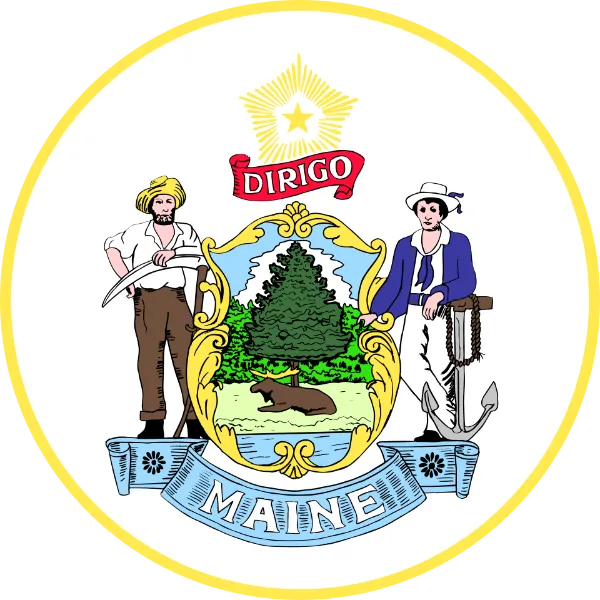
The motto appears on the Great Seal of Maine on a ribbon directly below the North Star. The North Star shines above the seal as its crest; Dirigo sits beneath it, linking the motto explicitly to the star it references. The central shield holds an Eastern white pine and a reclining moose. A farmer with a scythe stands to the left of the shield; a seaman with an anchor stands to the right.
The Maine state flag also displays the state seal at its center on a blue field, so the motto appears wherever the flag is shown. Official state documents, government buildings, and state publications use the seal with Dirigo visible in the design.
Maine State Motto Facts
- Maine's state motto is "Dirigo" — Latin for "I Lead."
- It has appeared on the Maine state seal since 1820, when Maine became the 23rd state on March 15.
- The motto sits directly below the North Star on the seal — the star sailors used to find true north.
- Maine became a state as part of the Missouri Compromise, admitted as a free state to balance Missouri's entry as a slave state.
- Maine is sometimes called the Dirigo State because of its motto.
- The motto is codified in Maine Revised Statutes Title 1, § 201.
Can You Match All 50 State Mottos?
Some questions show the original motto — Latin, Italian, Chinook — and ask which state it belongs to. Others give you the English translation and ask you to work backward. Both directions are harder than they look.
Take the State Mottos QuizQuick Answers
What is the Maine state motto?
What does "Dirigo" mean?
What is the English translation of "Dirigo"?
When did Maine adopt its state motto?
Why is Maine called the Dirigo State?
Maine State Symbols


Show more (2)


Related States


Compare all 50 states by population, land area, statehood date, and more.
Themed lists - states sharing the same bird, oldest symbols, flags with bears, and more.
Side-by-side comparison of population, area, income, taxes, climate, and more.
Top 20 most common surnames per state - with origins, meanings, and heritage context. Is yours on the list?
You Might Also Like

Serial Killers by State
Alaska has the highest serial killer rate at 0.867 per 100,000 residents. Hawaii is lowest, and California has the highest raw count at 128.

Flag of Arkansas
Arkansas had no state flag until 1913. Its white diamond marks the only diamond-producing state. A fourth star marks Confederate membership.

Flag of Arizona
Arizona's flag was sketched on an envelope in 1910 for a rifle team. Adopted in 1917, it became law without the governor's signature.

Flag of Alaska
Benny Benson designed Alaska's flag at 13. Eight gold stars on navy blue, the Big Dipper pointing to Polaris, adopted in 1927 and kept at statehood.

Alabama State Flag
Alabama's crimson cross on white was adopted in 1895, likely modeled after the Confederate Battle Flag. The state's first flag was destroyed by a storm one month after raising.

Flag of California
Brown grizzly on white, adopted in 1911, traces to settler William Todd's handmade flag raised at Sonoma on June 14, 1846.

Rainwater Harvesting Laws by State
Rainwater harvesting is legal in all 50 states. Colorado caps residential storage at 110 gallons, while Utah allows up to 2,500 gallons.

Weird Laws in Arkansas
Weird laws in Arkansas include a repealed statewide tattoo ban, a 145-year-old pronunciation law, and a Sunday car sales rule that is still enforced today.