Hawaii State Motto: Ua Mau ke Ea o ka ʻĀina i ka Pono
Ua Mau ke Ea o ka ʻĀina i ka Pono


Ua Mau ke Ea o ka ʻĀina i ka Pono
The motto appears on the state seal of Hawaii
- Motto
- Ua Mau ke Ea o ka ʻĀina i ka Pono
- Language
- Hawaiian
- Translation
- The Life of the Land Is Perpetuated in Righteousness
- Origin
- Spoken by King Kamehameha III, July 31, 1843
- Adopted as state motto
- 1959
Hawaii State Motto
Hawaii's state motto is Ua Mau ke Ea o ka ʻĀina i ka Pono, a Hawaiian-language phrase meaning The Life of the Land Is Perpetuated in Righteousness. King Kamehameha III spoke the words in 1843 and they became the motto of the Kingdom of Hawaii. When Hawaii became the 50th state in 1959, the phrase was carried into the new state's official symbols without change.
Hawaii is the only U.S. state with a motto in the Hawaiian language. Every other state uses English, Latin, Spanish, French, or Greek. The phrase is also unusual because it comes from a real, documented historical event rather than a committee or legislative session.
Hawaii State Motto Meaning
The motto is in the Hawaiian language. Ua Mau means is perpetuated or endures. Ke Ea is most often translated as the life or the sovereignty — the Hawaiian word ea carries both meanings. O ka ʻĀina means of the land. I ka Pono means in righteousness or in goodness.
The standard translation — The Life of the Land Is Perpetuated in Righteousness — reads the motto as a statement about the land enduring through right conduct. Some Hawaiian scholars prefer The Sovereignty of the Land Is Perpetuated in Righteousness, which foregrounds the political meaning ea carried in 1843, when Hawaiian independence had just been restored after months of foreign occupation.
The two readings are not contradictions. In 1843, the life of the land and its sovereignty were the same thing. A kingdom without sovereignty had no future.
Translation of "Ua Mau ke Ea o ka ʻĀina i ka Pono"
The official English translation used by the State of Hawaii is The Life of the Land Is Perpetuated in Righteousness. This version appears on Hawaii government websites and in official state publications.
The central word ea does not translate precisely into one English word. It can mean breath, life, sovereignty, or surface depending on context. When Kamehameha III spoke the phrase in 1843, the context was the restoration of political sovereignty, so ea carried a political weight that the word life does not fully capture in English. Both translations are used by credible Hawaiian sources.
History of Hawaii's State Motto
In February 1843, British naval officer Lord George Paulet arrived in Honolulu and, acting without authorization from the British government, claimed the Hawaiian Islands for Britain. King Kamehameha III was pressured into a provisional cession. The occupation lasted five months.
On July 31, 1843, Rear Admiral Richard Thomas arrived and restored Hawaiian sovereignty. At a ceremony in Honolulu, Kamehameha III spoke the words Ua Mau ke Ea o ka ʻĀina i ka Pono. That date is now observed in Hawaii as Lā Hoʻihoʻi Ea, Restoration Day.
The phrase became the official motto of the Kingdom of Hawaii and appeared on the royal coat of arms. It was preserved through the overthrow of the Hawaiian monarchy in 1893, through the territorial period beginning in 1900, and into statehood in 1959. The words have not changed.
"Ua Mau ke Ea o ka ʻĀina i ka Pono" on the Hawaii State Seal
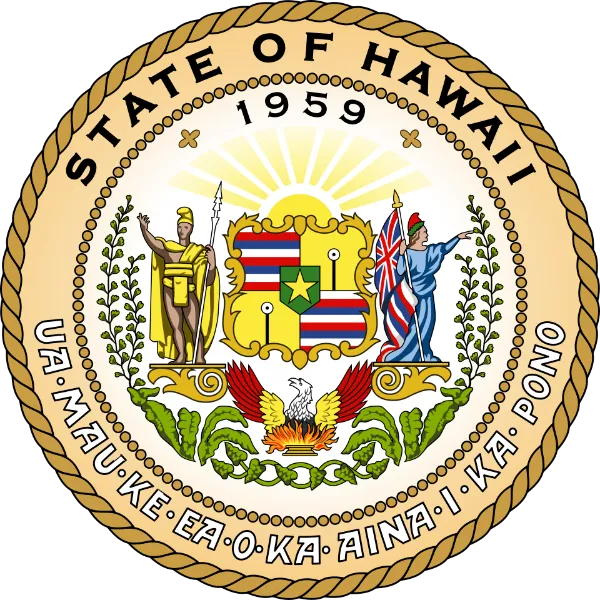
The motto appears along the lower arc of the Great Seal of Hawaii. The seal centers on the royal coat of arms of the Kingdom of Hawaii, flanked by King Kamehameha I on the right and the Goddess of Liberty on the left. A phoenix rises above the shield. Eight rays of the rising sun represent the eight main Hawaiian islands.
The motto's placement on the state seal has the longest continuous history of any element in the design. It has been in official use since the Kingdom of Hawaii era, more than a century before statehood.
Hawaii State Motto Facts
- Hawaii is the only U.S. state with a motto in the Hawaiian language.
- King Kamehameha III spoke the motto on July 31, 1843, at a ceremony restoring Hawaiian sovereignty after a five-month British occupation.
- July 31 is observed in Hawaii as Lā Hoʻihoʻi Ea — Restoration Day.
- The Hawaiian word ea can mean both life and sovereignty, giving the motto two valid English readings.
- The phrase passed from the Kingdom of Hawaii through the territorial period into the state motto designation in 1959 without any change in wording.
- The motto appears on the Great Seal of Hawaii, which is built around the royal coat of arms of the Kingdom of Hawaii.
Can You Match All 50 State Mottos?
Some questions show the original motto — Latin, Italian, Chinook — and ask which state it belongs to. Others give you the English translation and ask you to work backward. Both directions are harder than they look.
Take the State Mottos QuizQuick Answers
What is Hawaii's state motto?
What is the English translation of Hawaii's motto?
What language is Hawaii's state motto in?
When did Hawaii adopt its state motto?
Where does Hawaii's motto appear?
Sources
Hawaii State Symbols


Show more (2)


Related States


You Might Also Like

Gas Stations by State
Texas has the most gas stations of any state at 10,670, well ahead of California's 8,116. Alaska has the fewest of any state, with 200.

Chase Bank Locations by State
California has the most Chase Bank locations of any state at 900, about 17% of the US total. Hawaii and Alaska have none.

Dunkin' Donuts Locations by State
New York has the most Dunkin' Donuts locations at 1,453, followed by Massachusetts at 1,030. Seven states have none.

McDonald's Locations by State
Texas has the most McDonald's locations at 1,269, narrowly ahead of California's 1,234. North Dakota has the fewest of any state, with 24.

Wells Fargo Banks by State
California has the most Wells Fargo branches of any state at 823, nearly double Florida's second-place total of 498. Fourteen states have none.

Rodeo
The Wyoming state sport is rodeo, adopted in 2003. Cheyenne Frontier Days has run since 1897.

Rodeo
The Texas state sport is rodeo, adopted in 1997. Texas was the first state to name an official state sport.

Rodeo
The South Dakota state sport is rodeo, adopted in 2003. Its sponsor, Larry Rhoden, later became the state's governor.