Connecticut State Flag
Connecticut's flag traces its grapevines to a 1639 colony seal, despite its famously poor modern design ranking.

Connecticut State Flag
Official State Flag of Connecticut
State Flag of Connecticut
How Connecticut Got Its State Flag
Connecticut had no official state flag until 1897. Military flags used during the Civil War showed Connecticut regimental colors on blue fields, and citizens came to associate that blue with the state — but no law defined a state flag. In 1895, the Anna Warner Bailey Chapter of the Daughters of the American Revolution in Groton pushed for an official design. They wanted a flag to display in their new meeting room.
Governor O. Vincent Coffin introduced a bill on May 29, 1895. The legislature formed a committee. The DAR submitted designs. The Merriam Post of the Grand Army of the Republic argued for keeping the blue background established by Civil War military tradition. James J. Goodwin of the Connecticut Society of Colonial Wars submitted a competing design. The legislature compromised: azure blue field, the DAR's rococo-style shield.
The General Assembly adopted the flag in 1897, specifying dimensions of five feet six inches by four feet four inches and granting the Anna Warner Bailey Chapter the right to present the first official flag. The coat of arms on the flag was not formally standardized until March 24, 1931 — 34 years after the flag's adoption. Color standards followed in 1956, when the Secretary of State's office developed uniform specifications.
Connecticut's flag carries symbolism older than the state — and older than the United States. The grapevine design traces to the 1639 Saybrook Colony seal, making it one of the longest-running heraldic lineages in American civic symbolism, even if design critics consistently rank the flag last for visual clarity.
What the Grapevines and the Motto Actually Mean
The three grapevines have two competing interpretations, and Connecticut law has never chosen between them. One reading says they represent the three oldest European settlements in Connecticut: Hartford, Wethersfield, and Windsor — all founded in the 1630s. The other says they represent the three colonies that merged to form Connecticut: Connecticut Colony, Saybrook Colony, and New Haven Colony. Both readings are documented in historical sources. Neither is officially authoritative.
The connection between the vines and the motto is theological. The motto — Qui Transtulit Sustinet, Latin for He Who Transplanted Still Sustains — draws from Psalm 80: 'Thou hast brought a vine out of Egypt.' The vine imagery on the shield and the transplantation language in the motto reinforce each other directly. The phrase honored the colonists who uprooted themselves from England and, in the Puritan framing, were sustained by divine providence. The original Saybrook Colony seal from 1639 showed 15 vines. The colony reduced the number to three in 1711, 86 years before Connecticut used the design on a state flag.
The azure blue field is not colonial in origin. It came from the Civil War. Connecticut military regiments carried regimental colors on blue fields, and those flags became what residents associated with the state. When the legislature chose a background color in 1897, they ratified what military tradition had already established.
Shield, Vines, Motto — What Each Element Is
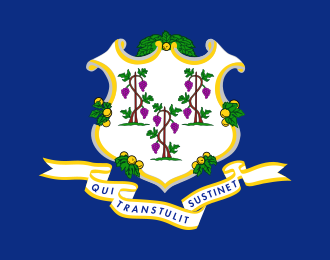

Qui Transtulit Sustinet

Rococo Shield & Grapevines

Three Grapevines

Azure Blue Field
Seven Colors, Standards Set Six Decades Later
Connecticut's flag uses seven colors: azure blue, white, gold, silver, brown, green, and purple. This is among the highest color counts of any U.S. state flag — a direct consequence of rendering a detailed heraldic coat of arms in full color. The complexity is part of why design critics consistently place the flag at or near the bottom of design rankings.
The 1897 law did not specify exact color values. Standards were developed by the Secretary of State's office and the State Purchasing Division in 1956 — 59 years after adoption. All seven colors are defined by Cable numbers. No Pantone values appear in Connecticut statute.
Interesting Facts
Quick Answers
What do the grapevines on Connecticut's flag mean?
What does Qui Transtulit Sustinet mean?
Why is Connecticut's flag blue?
When was Connecticut's flag officially adopted?
Why does Connecticut's flag rank last in design surveys?
Sources
Connecticut State Symbols


Show more (2)


Related States


Compare all 50 states by population, land area, statehood date, and more.
Themed lists - states sharing the same bird, oldest symbols, flags with bears, and more.
Side-by-side comparison of population, area, income, taxes, climate, and more.
Top 20 most common surnames per state - with origins, meanings, and heritage context. Is yours on the list?
You Might Also Like

Serial Killers by State
Alaska has the highest serial killer rate at 0.867 per 100,000 residents. Hawaii is lowest, and California has the highest raw count at 128.

Flag of Arkansas
Arkansas had no state flag until 1913. Its white diamond marks the only diamond-producing state. A fourth star marks Confederate membership.

Flag of Arizona
Arizona's flag was sketched on an envelope in 1910 for a rifle team. Adopted in 1917, it became law without the governor's signature.

Flag of Alaska
Benny Benson designed Alaska's flag at 13. Eight gold stars on navy blue, the Big Dipper pointing to Polaris, adopted in 1927 and kept at statehood.

Alabama State Flag
Alabama's crimson cross on white was adopted in 1895, likely modeled after the Confederate Battle Flag. The state's first flag was destroyed by a storm one month after raising.

Flag of California
Brown grizzly on white, adopted in 1911, traces to settler William Todd's handmade flag raised at Sonoma on June 14, 1846.

Rainwater Harvesting Laws by State
Rainwater harvesting is legal in all 50 states. Colorado caps residential storage at 110 gallons, while Utah allows up to 2,500 gallons.

Weird Laws in Arkansas
Weird laws in Arkansas include a repealed statewide tattoo ban, a 145-year-old pronunciation law, and a Sunday car sales rule that is still enforced today.