Virginia State Motto: Sic Semper Tyrannis
Sic Semper Tyrannis


Sic Semper Tyrannis
The motto appears on the state seal of Virginia
- Motto
- Sic Semper Tyrannis
- Language
- Latin
- Translation
- Thus Always to Tyrants
- Adopted
- 1776
Virginia State Motto
Virginia's state motto is Sic Semper Tyrannis, a Latin phrase meaning Thus Always to Tyrants. The Virginia Convention adopted the state seal — with the motto at the bottom — in 1776, the same year Virginia declared independence from Britain.
The motto is one of the oldest in the United States. It was part of Virginia's official identity from the first days of the American Revolution and has appeared on the seal and the state flag ever since.
Virginia State Motto Meaning
Sic Semper Tyrannis is Latin for Thus Always to Tyrants. The phrase is a warning: this is how tyrants always end — defeated, fallen, stripped of their power.
The meaning is shown visually on the seal itself. Virtus, a female figure representing virtue and Virginia, stands as a warrior over a prostrate tyrant. The tyrant's crown has fallen from his head. A chain and a whip lie near him — symbols of the oppression he practiced. Virtus holds a spear and wears a sheathed sword at her side.
The image and the motto work together. Where many states chose mottos of aspiration or hope, Virginia chose a statement of consequence: tyranny ends in defeat.
History of Virginia's State Motto
The Virginia Convention adopted the Great Seal of Virginia in 1776, the same year Virginia became the first of the thirteen colonies to adopt a state constitution. George Wythe, a Virginia lawyer and signer of the Declaration of Independence who later served as Thomas Jefferson's law teacher, is credited with designing the seal and choosing the motto.
The motto was written at a moment when Virginia's leaders saw the American Revolution as exactly the kind of struggle the phrase described: a people casting off tyranny. The seal's design made that argument in visual form, and the Latin motto gave it a classical weight that Virginia's founders valued.
The phrase entered wider public consciousness on April 14, 1865, when John Wilkes Booth reportedly shouted it after shooting President Abraham Lincoln at Ford's Theatre in Washington. Booth was from Maryland, not Virginia, but the phrase he chose was Virginia's state motto. The event gave the motto a second, darker layer of association that has followed it ever since.
"Sic Semper Tyrannis" on the Virginia State Seal
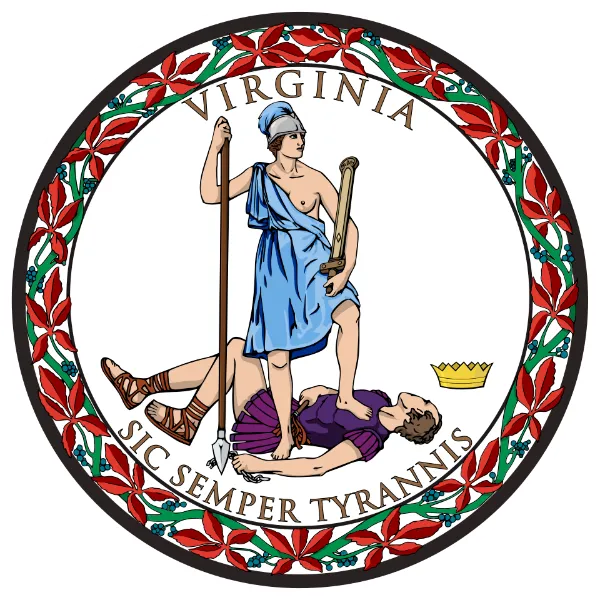
"Sic Semper Tyrannis" appears at the bottom of the Virginia state seal, below the central figure of Virtus standing over the prostrate tyrant. "Virginia" appears at the top. The seal has been used on official documents, government correspondence, and state buildings since 1776.
The motto and seal design also appear on the Virginia state flag, which shows the seal on a blue background. The Code of Virginia formally designates the seal, its design, and its elements as official state symbols.
Virginia State Motto Facts
- "Sic Semper Tyrannis" means "Thus Always to Tyrants" in Latin.
- The Virginia Convention adopted the seal with the motto in 1776, making it one of the oldest state mottos in the United States.
- George Wythe, who later taught law to Thomas Jefferson, is credited with designing the seal and choosing the motto.
- The seal shows Virtus, a warrior figure representing Virginia, standing over a prostrate tyrant with a fallen crown.
- John Wilkes Booth reportedly shouted the phrase after shooting President Lincoln on April 14, 1865.
Can You Match All 50 State Mottos?
Some questions show the original motto — Latin, Italian, Chinook — and ask which state it belongs to. Others give you the English translation and ask you to work backward. Both directions are harder than they look.
Take the State Mottos QuizQuick Answers
What is Virginia's state motto?
What is the English translation of "Sic Semper Tyrannis"?
What does the Virginia state seal show?
When was Virginia's state motto adopted?
Did John Wilkes Booth say "Sic Semper Tyrannis"?
Sources
Virginia State Symbols


Show more (2)


Related States


Compare all 50 states by population, land area, statehood date, and more.
Themed lists - states sharing the same bird, oldest symbols, flags with bears, and more.
Side-by-side comparison of population, area, income, taxes, climate, and more.
Top 20 most common surnames per state - with origins, meanings, and heritage context. Is yours on the list?
You Might Also Like

Serial Killers by State
Alaska has the highest serial killer rate at 0.867 per 100,000 residents. Hawaii is lowest, and California has the highest raw count at 128.

Flag of Arkansas
Arkansas had no state flag until 1913. Its white diamond marks the only diamond-producing state. A fourth star marks Confederate membership.

Flag of Arizona
Arizona's flag was sketched on an envelope in 1910 for a rifle team. Adopted in 1917, it became law without the governor's signature.

Flag of Alaska
Benny Benson designed Alaska's flag at 13. Eight gold stars on navy blue, the Big Dipper pointing to Polaris, adopted in 1927 and kept at statehood.

Alabama State Flag
Alabama's crimson cross on white was adopted in 1895, likely modeled after the Confederate Battle Flag. The state's first flag was destroyed by a storm one month after raising.

Flag of California
Brown grizzly on white, adopted in 1911, traces to settler William Todd's handmade flag raised at Sonoma on June 14, 1846.

Rainwater Harvesting Laws by State
Rainwater harvesting is legal in all 50 states. Colorado caps residential storage at 110 gallons, while Utah allows up to 2,500 gallons.

Weird Laws in Arkansas
Weird laws in Arkansas include a repealed statewide tattoo ban, a 145-year-old pronunciation law, and a Sunday car sales rule that is still enforced today.