Texas State Motto: Friendship
Friendship


Friendship
The motto appears on the state seal of Texas
- Motto
- Friendship
- Language
- English
- Adopted
- 1930
Texas State Motto
Texas's state motto is Friendship. It is a single English word, adopted by the 41st Texas Legislature in February 1930.
The choice reflects the origin of the state's name. The Caddo people of East Texas used the word táyshaʼ to mean "friends" or "allies." Spanish explorers wrote it as Tejas, which over time became Texas.
Texas State Motto Meaning
"Friendship" is a plain English word, but Texas chose it because the state's name comes from a word meaning exactly that.
The Caddo people, an indigenous nation of East Texas, Louisiana, Arkansas, and Oklahoma, used táyshaʼ as a greeting meaning "friends" or "allies." Spanish missionaries and explorers heard it and wrote it as Tejas (pronounced teh-has). That became Texas.
The motto ties the state's identity back to that original meaning — Texas as a place named by and for friendship.
History of Texas's State Motto
The Texas Legislature adopted "Friendship" as the official state motto in February 1930 during the 41st legislative session.
The choice acknowledged the meaning behind the state's name. Texas Government Code § 3101.001 now formally designates "Friendship" as the official state motto.
"Friendship" on the Texas State Seal
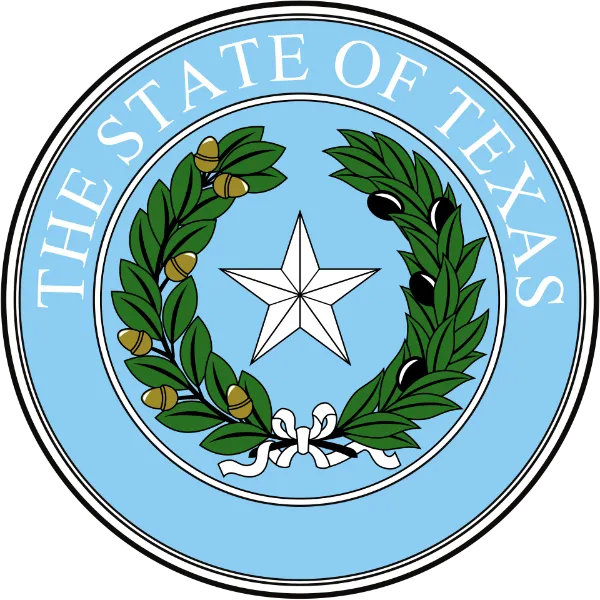
The Texas state seal shows a lone star surrounded by a live oak branch on the right and an olive branch on the left, with the words "THE STATE OF TEXAS" around the border.
The motto "Friendship" is codified in Texas Government Code § 3101.001 and appears in official state publications and documents alongside other Texas state symbols.
Texas State Motto Facts
- Texas's state motto is "Friendship," adopted in February 1930.
- The motto connects to the Caddo word táyshaʼ, meaning "friends" or "allies" — the origin of the name Texas.
- The Caddo were an indigenous people of East Texas, Louisiana, Arkansas, and Oklahoma.
- Spanish explorers wrote the Caddo greeting as Tejas, which became the name Texas.
- Texas Government Code § 3101.001 formally designates "Friendship" as the state motto.
Can You Match All 50 State Mottos?
Some questions show the original motto — Latin, Italian, Chinook — and ask which state it belongs to. Others give you the English translation and ask you to work backward. Both directions are harder than they look.
Take the State Mottos QuizQuick Answers
What is Texas's state motto?
What does "Friendship" mean as a state motto?
When did Texas adopt "Friendship" as its state motto?
Texas State Symbols


Show more (2)


Related States


You Might Also Like

Gas Stations by State
Texas has the most gas stations of any state at 10,670, well ahead of California's 8,116. Alaska has the fewest of any state, with 200.

Chase Bank Locations by State
California has the most Chase Bank locations of any state at 900, about 17% of the US total. Hawaii and Alaska have none.

Dunkin' Donuts Locations by State
New York has the most Dunkin' Donuts locations at 1,453, followed by Massachusetts at 1,030. Seven states have none.

McDonald's Locations by State
Texas has the most McDonald's locations at 1,269, narrowly ahead of California's 1,234. North Dakota has the fewest of any state, with 24.

Wells Fargo Banks by State
California has the most Wells Fargo branches of any state at 823, nearly double Florida's second-place total of 498. Fourteen states have none.

Rodeo
The Wyoming state sport is rodeo, adopted in 2003. Cheyenne Frontier Days has run since 1897.

Rodeo
The Texas state sport is rodeo, adopted in 1997. Texas was the first state to name an official state sport.

Rodeo
The South Dakota state sport is rodeo, adopted in 2003. Its sponsor, Larry Rhoden, later became the state's governor.