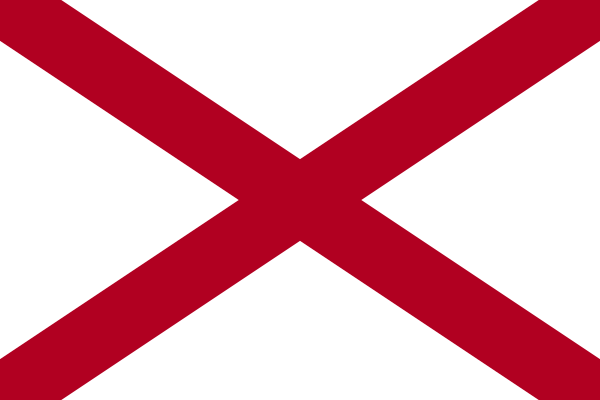
Crimson St. Andrew's Cross
Alabama's state flag is a crimson St. Andrew's Cross on a white field, adopted February 16, 1895. Learn its history, the Confederate and Scottish readings of its design, the 1861 flag it replaced, and why it still generates debate.
Crimson St. Andrew's Cross
Official State Flag of Alabama
- Official flag
- Crimson cross
- Adopted
- 1895
- Colors
- Crimson, white
- Shape in law
- Unspecified
The Cross: Scotland, the Saltire, and Confederate Echoes
The Crimson Saltire
The design on Alabama's flag is a saltire — the heraldic term for a diagonal cross. Its name in Alabama law is the St. Andrew's Cross, after the apostle Andrew, who according to tradition was crucified on an X-shaped frame rather than the upright Latin cross. That is the shape's oldest documented identity: a martyr's cross, adopted centuries later as the national emblem of Scotland, where a white saltire on a blue field has flown since the Middle Ages and still anchors the flags of the United Kingdom.
No Alabama law cites Scotland, and no legislative record mentions St. Andrew beyond naming the cross type. But the shape carries that ancestry regardless of intent — it places Alabama's state flag in a tradition of saltires that runs from the Scottish Highlands through the British Isles and into the Atlantic world.
The more contested connection runs in a different direction. The Confederate Battle Flag used the same diagonal cross in blue on a red field. When John W. A. Sanford Jr. introduced the Alabama flag bill in early 1895, that design was not distant history. The Confederate Battle Flag had been in active circulation for thirty years. Across the former Confederacy, state governments were working to rehabilitate Confederate memory: erecting monuments, renaming buildings, and embedding Confederate imagery into official symbols. Alabama's choice of a crimson saltire in that climate was not made in a vacuum.
The red saltire looks spare on the page, but it has never been read lightly. The same diagonal cross points in two directions at once — toward a medieval Scottish martyr and toward the most recognizable symbol of the Confederate South. That dual inheritance is what makes Alabama's flag visually simple and historically loaded.
"A crimson cross of St. Andrew on a field of white. The bars of the cross not less than six inches broad and must extend diagonally across the flag from side to side."
The Same Cross, Three Histories
The same diagonal cross can point to very different histories. That is part of why Alabama's flag has never been read in only one way.
Alabama State Flag
1895Crimson saltire on white. Adopted February 16, 1895. No official symbolism stated in law.
- Cross
- Crimson
- Field
- White
Scottish Saltire
c. 1542 (formal use)White saltire on blue. Scotland's national flag and one of the oldest national emblems in continuous use. Named for St. Andrew, patron saint of Scotland.
- Cross
- White
- Field
- Blue
Confederate Battle Flag
1861Blue saltire with thirteen white stars on a red field. Used by Confederate armies during the Civil War. Later adopted as a symbol of Southern resistance and Confederate memory.
- Cross
- Blue
- Field
- Red
Why the Alabama Flag Still Feels Controversial
The timing of adoption tells its own story. The legislature voted in February 1895 — not in the immediate aftermath of the Civil War, but thirty years later, during the peak of what historians call the Lost Cause movement. Across the former Confederacy, civic and legislative bodies were actively working to reframe the war's meaning: erecting statues, instating Confederate holidays, and inscribing a specific version of Southern identity into public space.
Alabama's 1895 flag fits that pattern. So does the Mississippi state flag, adopted the same year with a Confederate Battle Flag canton. So does the surge in Confederate monument construction that crested between 1895 and 1920. These were not coincidences of timing. They were a coordinated political project, using symbols to argue about who controlled the South's public identity in the decades after Reconstruction.
No surviving floor debate or committee report from 1895 explicitly states that Alabama's flag was meant to honor Confederate memory. The Code of Alabama identifies the cross type, specifies the color, sets the bar width, and stops there. But historians and civil rights scholars — including those writing for the Encyclopedia of Alabama — have consistently pointed to the adoption date, the Lost Cause context, and the parallel actions across Southern legislatures as evidence that the Confederate reading was understood, even if unspoken.
That is why the flag still generates debate. The design has not changed in 130 years, and neither have the conversations around it. A crimson cross on white is not inherently charged — but adopted in Alabama in 1895, flown through the Jim Crow era, and now carried into arguments about Confederate monuments and public memory, it has never been a neutral object. Few state flags say so little visually while carrying so much historical weight.
The 1861 Flag Alabama Never Made Official
In January 1861, as Alabama prepared to leave the Union, a group of women from Montgomery designed a flag and presented it to the Secession Convention. It was blue silk, and it said everything the 1895 flag would later refuse to say. On the front: the Goddess of Liberty holding a sword and a lone-star flag, referencing Alabama's brief existence as an independent republic before it joined the Confederacy. On the back: a cotton plant, a coiled rattlesnake, and the Latin motto Noli Me Tangere — Touch Me Not.
It was theatrical, specific, and symbolically dense. Every element announced its meaning: the rattlesnake reaching back to revolutionary-era American iconography, the cotton plant naming the economic order the secession was defending, the Goddess of Liberty making the political argument in the open. Nothing was left open to interpretation.
The flag was reportedly lost within weeks, some accounts attributing its destruction to storm damage. Alabama went through the Civil War, Reconstruction, and readmission to the Union without an official state flag. That gap lasted nearly thirty-five years.
The 1895 flag could not have been more different. Where the 1861 design crowded every symbol it could carry onto blue silk, the 1895 act described a plain white field with two diagonal bars and nothing else. No figure, no motto, no reference to cotton or independence or liberty. The stripping-away was total. Whether that minimalism reflected deliberate restraint, political calculation, or simply a different era's aesthetic, the contrast between the two flags remains one of the sharpest in Alabama's visual history.
Secession Convention Flag
Blue silk flag presented to the Alabama Secession Convention, January 11, 1861. Obverse: Goddess of Liberty with sword and lone-star flag. Reverse: cotton plant, coiled rattlesnake, motto Noli Me Tangere. Never formally adopted. Reportedly lost to storm damage within weeks.
Current State Flag
A crimson St. Andrew's Cross on a white field. Adopted February 16, 1895. Unchanged since.
Timeline
Montgomery women present a blue silk flag to the Alabama Secession Convention on January 11. One side shows the Goddess of Liberty; the reverse shows a cotton plant, a coiled rattlesnake, and the motto Noli Me Tangere. Never officially adopted. Reportedly lost to storm damage within weeks.
Alabama is readmitted to the Union after the Civil War. The state has no official flag for nearly thirty-five years.
John W. A. Sanford Jr. introduces the flag bill in the Alabama House. On February 16, 1895, Alabama officially adopts a crimson St. Andrew's Cross on a white field as its state flag.
Alabama's attorney general issues an advisory opinion that the flag should be rectangular rather than square. The statute is not amended; both proportions remain in use.
Alabama passes a new State Flag Act consolidating display rules and preservation guidelines. The design is unchanged.
Square or Rectangular? The Detail That Never Fully Settled
Look at official Alabama flag images side by side and you will notice something: they do not all match. Some are square. Others are rectangular, proportioned like a standard American flag. Both appear on government buildings, in official publications, and on commercially sold flags. This is not a manufacturing inconsistency. It is a legal gap that has been open since 1895.
The original flag act specifies bar width — not less than six inches broad — but says nothing about the flag's overall dimensions. That small omission left the question of shape entirely unresolved. For decades the default was square: early official depictions used a 1:1 ratio, and many historical and institutional flags still do.
In 1987, Alabama's attorney general issued an advisory opinion arguing the flag should be rectangular, consistent with standard American flag proportions. An advisory opinion is not law — it is an interpretation, not a statute — but it carries real weight in how state agencies operate. Rectangular versions became the norm in newer official contexts.
The 1895 statute has never been amended. Square versions remain in historical collections, older government buildings, and among collectors — and the flag has flown in two different shapes for more than a century without the legislature ever choosing between them.
Crimson and White: A Simple Palette With Heavy Associations
Two colors. That is the entire visual vocabulary of the Alabama flag. A crimson cross against a white field — no gradient, no shading, no third element to soften or complicate the composition. The starkness is deliberate in its effect, whether or not it was deliberate in its design. Strip a flag to two high-contrast colors and a single shape, and every element becomes harder to ignore.
Crimson is a deep, cool red — darker than standard red, closer to burgundy. Alabama law uses the word 'crimson' but specifies no Pantone, CMYK, or hex value, which is why no two official reproductions have ever been required to match exactly. The hex #A6192E is commonly used in digital contexts, but it is a convention, not a legal standard. Fly the flag in different light and the crimson shifts: brick-red in direct sun, deeper and cooler in shade.
The two-color combination became Alabama's traditional state colors by association rather than by any separate legislative act. The flag specified them first in 1895; the association followed from use. What the colors officially mean has never been stated anywhere in law. But that is exactly the point. The stripped-down palette gives the flag its force — there is no crest to examine, no scroll to read, no seal to hide behind. Just a red diagonal cross on white, and everything people decide to see in it.
Years the Alabama flag design has been in use, unchanged since February 16, 1895 — adopted under a law brief enough to fit in a single paragraph
Test your knowledge
Quick Answers
What is the Alabama state flag?
When was the Alabama state flag adopted?
Who introduced the Alabama state flag legislation?
What does the X on the Alabama flag represent?
Is the Alabama flag connected to the Confederacy?
Is the Alabama flag square or rectangular?
Did Alabama have a state flag before 1895?
What shade of crimson does Alabama's flag use?
Sources
- Alabama Legislature — Code of Alabama § 1-2A-2 (State Flag)
- Alabama Department of Archives and History — State Flag
- Encyclopedia of Alabama — State Flag
- Alabama 2001 State Flag Act
Related Symbols
Show more (2)
Compare all 50 states by population, land area, statehood date, and more.
Themed lists - states sharing the same bird, oldest symbols, flags with bears, and more.
Side-by-side comparison of population, area, income, taxes, climate, and more.
Top 20 most common surnames per state - with origins, meanings, and heritage context. Is yours on the list?