Washington State Motto: Alki
Alki


Alki
The motto appears on the state seal of Washington
- Territorial Motto
- Alki
- Language
- Chinook Jargon
- Translation
- By and By
- Official Motto
- None
Washington State Motto
Washington has no official state motto. It is the only U.S. state that has never passed a law designating one. All 49 other states have at least one officially adopted motto.
The word Alki (also written Al-ki) is listed as Washington's territorial motto on the state legislature's own website. It appeared on the territorial seal from 1854 through 1889, when it was dropped at statehood and never restored.
What Does "Alki" Mean?
In Chinook Jargon, alki means by and by or eventually — patient optimism about something not yet reached. The word described a belief that something good was coming, in time.
Chinook Jargon was a Pacific Northwest trade language combining Chinook and Nuu-chah-nulth Indigenous words with French and English borrowings. Fur traders, missionaries, settlers, and Native Americans used it across Oregon, Washington, British Columbia, and Idaho throughout the 1800s.
History of Washington's Territorial Motto
On November 13, 1851, Arthur Denny's party of 24 settlers arrived at a beach on the west shore of Elliott Bay. They named the settlement New York-Alki: New York after settler Charles Terry's home state, and Alki because they believed it would someday grow as large. Most of the party moved across the bay the following year and founded Seattle.
Lieutenant J.K. Duncan, part of Governor Isaac Stevens' surveying expedition, designed the Washington territorial seal. He placed Alki beneath the Goddess of Hope, who holds an anchor and points toward the word. The design was described in Olympia's Pioneer and Democrat newspaper on February 25, 1854.
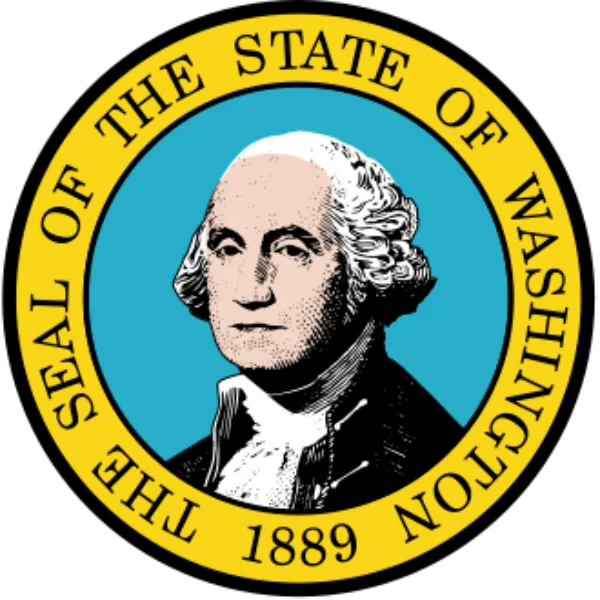
When Washington became the 42nd state on November 11, 1889, jeweler Charles Talcott created a new seal. He based the design on a postage stamp portrait of George Washington and included no motto. The legislature adopted that seal and has never passed a bill to add one.
"Alki" on the Washington Territorial Seal
On the territorial seal, the Goddess of Hope holds an anchor and points down toward the word Alki. The seal also showed a log cabin and immigrant wagon with a fir forest on one side, and a steamer crossing a sheet of water toward a city on the other.
The word does not appear on the current state seal, which shows George Washington's portrait with the state name and the year 1889. It does not appear on the state flag, which carries the state seal on a green field.
Washington State Motto Facts
- Washington is the only U.S. state that has never officially adopted a state motto.
- "Alki" is a Chinook Jargon word meaning "by and by" or "eventually."
- The territorial seal with Alki was described in Olympia's Pioneer and Democrat newspaper on February 25, 1854.
- Arthur Denny's party named their 1851 settlement New York-Alki, meaning "New York, someday."
- Charles Talcott designed the 1889 state seal using a postage stamp portrait of George Washington. No motto was included.
- Washington has official symbols for dozens of categories — bird, tree, flower, flag, fish — but a motto is not among them.
Can You Match All 50 State Mottos?
Some questions show the original motto — Latin, Italian, Chinook — and ask which state it belongs to. Others give you the English translation and ask you to work backward. Both directions are harder than they look.
Take the State Mottos QuizQuick Answers
What is Washington's state motto?
What does "Alki" mean?
What language is "Alki" from?
Why does Washington have no state motto?
Sources
- Washington State Legislature — Territorial Motto
- Washington State Legislature — Territorial History
- Washington Secretary of State — Archives Treasures: Territorial Seal
Washington State Symbols


Show more (2)


Related States


Compare all 50 states by population, land area, statehood date, and more.
Themed lists - states sharing the same bird, oldest symbols, flags with bears, and more.
Side-by-side comparison of population, area, income, taxes, climate, and more.
Top 20 most common surnames per state - with origins, meanings, and heritage context. Is yours on the list?
You Might Also Like

Serial Killers by State
Alaska has the highest serial killer rate at 0.867 per 100,000 residents. Hawaii is lowest, and California has the highest raw count at 128.

Flag of Arkansas
Arkansas had no state flag until 1913. Its white diamond marks the only diamond-producing state. A fourth star marks Confederate membership.

Flag of Arizona
Arizona's flag was sketched on an envelope in 1910 for a rifle team. Adopted in 1917, it became law without the governor's signature.

Flag of Alaska
Benny Benson designed Alaska's flag at 13. Eight gold stars on navy blue, the Big Dipper pointing to Polaris, adopted in 1927 and kept at statehood.

Alabama State Flag
Alabama's crimson cross on white was adopted in 1895, likely modeled after the Confederate Battle Flag. The state's first flag was destroyed by a storm one month after raising.

Flag of California
Brown grizzly on white, adopted in 1911, traces to settler William Todd's handmade flag raised at Sonoma on June 14, 1846.

Rainwater Harvesting Laws by State
Rainwater harvesting is legal in all 50 states. Colorado caps residential storage at 110 gallons, while Utah allows up to 2,500 gallons.

Weird Laws in Arkansas
Weird laws in Arkansas include a repealed statewide tattoo ban, a 145-year-old pronunciation law, and a Sunday car sales rule that is still enforced today.