Utah State Motto: Industry
Industry


Industry
The motto appears on the state seal of Utah
- Motto
- Industry
- Language
- English
- Adopted
- 1896
Utah State Motto
Utah's state motto is Industry. It is a single English word, adopted at statehood on January 4, 1896, when Utah entered the Union as the 45th state.
The beehive is Utah's state emblem and appears on the state seal directly alongside the motto. Together they represent the cooperative hard work of the Mormon pioneers who settled Utah beginning in 1847.
Utah State Motto Meaning
"Industry" means diligent, productive labor. For the Mormon pioneers who settled the Salt Lake Valley, it described the collective effort required to build communities in a desert region with few resources and no outside support.
The beehive was the central symbol of that idea. A beehive only works through organized, steady effort — every worker contributing to a shared goal. Brigham Young and early Church of Jesus Christ of Latter-day Saints leaders used the beehive as a model for how pioneer settlements should operate.
The word also connects to the proposed name for the territory. In 1849, Brigham Young proposed calling the region Deseret, a word from the Jaredite language in the Book of Mormon meaning "honeybee." Congress rejected that name and created Utah Territory in 1850, but the beehive and the idea of industry remained at the center of Utah's identity.
History of Utah's State Motto
The beehive and the word "Industry" appeared on the seal of the proposed State of Deseret in 1849, years before Utah was a U.S. territory. When Congress established Utah Territory in 1850, the beehive emblem carried over and remained on the territorial seal.
When Utah achieved statehood on January 4, 1896, the state constitution and official seal retained "Industry" as the motto. It has not changed since.
"Industry" on the Utah State Seal
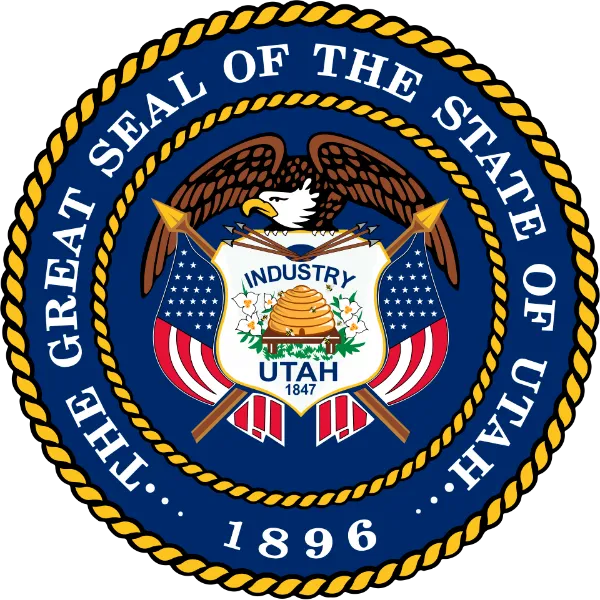
"Industry" appears on the Utah state seal directly below the beehive at the center of the design. The seal also shows sego lilies on each side of the beehive, an American flag on each side, an eagle at the top, and the dates 1847 (the year pioneers arrived) and 1896 (the year of statehood).
The beehive and "Industry" also appear on the Utah state flag. Utah Code formally designates both the seal and the motto as official state symbols.
Utah State Motto Facts
- Utah's state motto is "Industry," adopted at statehood in 1896.
- The word "Deseret," the pioneers' proposed name for Utah, means "honeybee" in the Jaredite language of the Book of Mormon.
- The beehive, Utah's state emblem, appears on the state seal directly alongside the motto.
- Congress rejected the name Deseret in 1850 and created Utah Territory instead, but the beehive symbol remained.
- "Industry" has appeared on Utah's official seal since before statehood — it was on the proposed State of Deseret seal in 1849.
Can You Match All 50 State Mottos?
Some questions show the original motto — Latin, Italian, Chinook — and ask which state it belongs to. Others give you the English translation and ask you to work backward. Both directions are harder than they look.
Take the State Mottos QuizQuick Answers
What is Utah's state motto?
What does "Industry" mean as a state motto?
What is the connection between Utah's motto and the word Deseret?
When did Utah adopt "Industry" as its state motto?
Sources
- Utah Division of State History — Utah State Symbols
- Utah State Legislature — Utah Code, State Symbols
- Church History Museum — Deseret and the Beehive
Utah State Symbols


Show more (2)


Related States


Compare all 50 states by population, land area, statehood date, and more.
Themed lists - states sharing the same bird, oldest symbols, flags with bears, and more.
Side-by-side comparison of population, area, income, taxes, climate, and more.
Top 20 most common surnames per state - with origins, meanings, and heritage context. Is yours on the list?
You Might Also Like

Serial Killers by State
Alaska has the highest serial killer rate at 0.867 per 100,000 residents. Hawaii is lowest, and California has the highest raw count at 128.

Flag of Arkansas
Arkansas had no state flag until 1913. Its white diamond marks the only diamond-producing state. A fourth star marks Confederate membership.

Flag of Arizona
Arizona's flag was sketched on an envelope in 1910 for a rifle team. Adopted in 1917, it became law without the governor's signature.

Flag of Alaska
Benny Benson designed Alaska's flag at 13. Eight gold stars on navy blue, the Big Dipper pointing to Polaris, adopted in 1927 and kept at statehood.

Alabama State Flag
Alabama's crimson cross on white was adopted in 1895, likely modeled after the Confederate Battle Flag. The state's first flag was destroyed by a storm one month after raising.

Flag of California
Brown grizzly on white, adopted in 1911, traces to settler William Todd's handmade flag raised at Sonoma on June 14, 1846.

Rainwater Harvesting Laws by State
Rainwater harvesting is legal in all 50 states. Colorado caps residential storage at 110 gallons, while Utah allows up to 2,500 gallons.

Weird Laws in Arkansas
Weird laws in Arkansas include a repealed statewide tattoo ban, a 145-year-old pronunciation law, and a Sunday car sales rule that is still enforced today.