South Dakota State Motto: Under God the People Rule
Under God the People Rule


Under God the People Rule
The motto appears on the state seal of South Dakota
- Motto
- Under God the People Rule
- Language
- English
- Designed
- 1885
- Adopted at statehood
- November 2, 1889
- Designer
- Reverend Joseph Ward
South Dakota State Motto
South Dakota's state motto is Under God the People Rule, written in plain English rather than Latin. Reverend Joseph Ward proposed it at the 1885 Constitutional Convention, four years before South Dakota became a state. It arcs across the top of the state seal in black letters on a golden background.
Most state mottos from the 1880s used Latin. Ward's choice of English was deliberate: he wanted every citizen to be able to read the state's founding principle without education in classical languages. South Dakota is one of a small number of states with a motto that explicitly names God.
South Dakota State Motto Meaning
The phrase combines two distinct ideas. Under God asserts that human government operates within a framework of divine authority. The People Rule asserts popular sovereignty — that citizens hold political power.
Ward was a Congregationalist minister, and the theological framing was intentional, not decorative. He placed divine authority above popular rule, but made popular rule the active claim. The result is a motto that reads as both a civic statement and a religious one.
The plain English structure also meant the motto could be read aloud by anyone at a town meeting, printed in a newspaper, and understood by immigrants still learning American political language. That accessibility was part of Ward's purpose in 1885.
History of South Dakota's State Motto
South Dakota tried to become a state twice before it succeeded. A first constitutional convention met in 1883 and applied for statehood; Congress refused. A second convention met in 1885, and Reverend Joseph Ward chaired the Committee on the Great Seal. Ward proposed both the visual design of the seal and the motto, and the 1885 convention adopted both. Congress again declined to admit South Dakota.
Ward was a Congregationalist minister who had founded Yankton College in 1881. He brought both a classical education and a frontier minister's practical sense to the task. Where other states had reached for Latin to signal republican tradition, Ward reached for plain English to signal democratic access. The phrase he wrote expressed his theology and his view of democratic government in six words.
Congress passed the Omnibus Admission Act in 1889, and South Dakota held a third constitutional convention that retained Ward's 1885 seal and motto with only minor modifications. South Dakota and North Dakota were both admitted on November 2, 1889. Ward died on December 11, 1889, forty days after seeing the statehood he had worked toward.
"Under God the People Rule" on the South Dakota State Seal
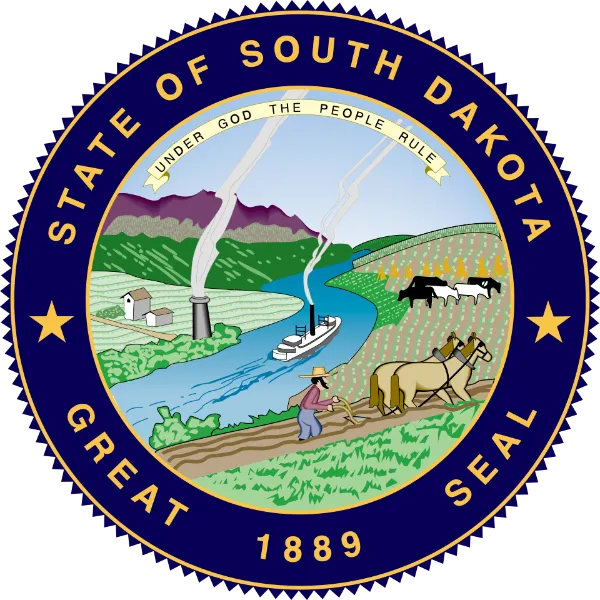
The motto arcs across the top of the Great Seal of South Dakota in black letters on a golden background. Below the motto, the seal shows a landscape of the territory's four industries: mining and smelting on the left, farming on the right, a steamboat on the Missouri River between them, and cattle with cornfields in the background hills.
The seal is defined in the South Dakota Constitution, Article XXI, Section 1. It appears on official state documents, government buildings, and state publications. The motto has been in the same position on the seal since Ward's 1885 design.
South Dakota State Motto Facts
- South Dakota's state motto is "Under God the People Rule" — written in English, not Latin.
- Reverend Joseph Ward proposed it at the 1885 Constitutional Convention, four years before statehood.
- Ward was a Congregationalist minister who founded Yankton College in Yankton, South Dakota, in 1881.
- Most state mottos of the 1880s used Latin; Ward chose English so every citizen could read it without translation.
- South Dakota and North Dakota were both admitted to the Union on November 2, 1889.
- Ward died on December 11, 1889, forty days after South Dakota's admission to statehood.
Can You Match All 50 State Mottos?
Some questions show the original motto — Latin, Italian, Chinook — and ask which state it belongs to. Others give you the English translation and ask you to work backward. Both directions are harder than they look.
Take the State Mottos QuizQuick Answers
What is South Dakota's state motto?
What does "Under God the People Rule" mean?
Why is South Dakota's motto in English and not Latin?
When did South Dakota adopt its state motto?
Sources
- South Dakota Secretary of State — State Symbols
- South Dakota Constitution, Article XXI, Section 1
- South Dakota State Historical Society
South Dakota State Symbols


Show more (2)


Related States


Compare all 50 states by population, land area, statehood date, and more.
Themed lists - states sharing the same bird, oldest symbols, flags with bears, and more.
Side-by-side comparison of population, area, income, taxes, climate, and more.
Top 20 most common surnames per state - with origins, meanings, and heritage context. Is yours on the list?
You Might Also Like

Stand Your Ground Laws by State
30 states have statutory Stand Your Ground laws with no duty to retreat. 11 states require retreat before using deadly force in public.

Best Healthcare by State
Hawaii leads all states with a healthcare score of 87.6. Alaska ranks last at 27.8, with West Virginia and Mississippi also below 30.

Squatters Rights by State
Arizona has one of the shortest adverse possession periods at 3 years, while New Jersey and Texas require up to 30 years.

Age of Consent by State
32 states set the age of consent at 16. California and Florida require 18. Romeo and Juliet exemption status for all 50 states.

Basilosaurus Whale
The Alabama state fossil is the Basilosaurus Whale (Basilosaurus cetoides), adopted in 1984. Fossils are found in southwest Alabama's Eocene deposits.

Petrified Wood
The Arizona state fossil is Petrified Wood (Araucarioxylon arizonicum), adopted in 1988. Fossil logs are found throughout Petrified Forest National Park.

Colorado State Colors
Official Colorado state colors are Blue and White, adopted in 1911. Blue reflects the sky and the columbine, white the Rocky Mountain snow.

Alabama State Colors
Crimson and white are Alabama's traditional state colors, taken from the 1895 state flag's wide saltire cross on a white field.