Pennsylvania State Motto: Virtue, Liberty, and Independence
Virtue, Liberty, and Independence


Virtue, Liberty, and Independence
The motto appears on the state seal of Pennsylvania
- Motto
- Virtue, Liberty, and Independence
- Language
- English
- First on coat of arms
- 1778
- Officially adopted
- 1875
Pennsylvania State Motto
Pennsylvania's state motto is Virtue, Liberty, and Independence. It appears on the Pennsylvania coat of arms as a ribbon below the shield, and the coat of arms is displayed on the state flag.
The motto is one of the oldest in American state history. It was placed on the coat of arms in 1778, the same year the Articles of Confederation were adopted, while Philadelphia was still serving as the nation's center of government.
Pennsylvania State Motto Meaning
The three words together described the values Pennsylvania stood for during the Revolutionary War. Each word carried a specific meaning for the people who created the motto in 1778.
Virtue meant good moral character — acting with honesty and integrity rather than self-interest. Liberty meant freedom from rule imposed without consent, the central grievance that drove the colonies to break with Britain. Independence meant self-governance, the ability to make your own laws and choose your own leaders.
Placed together at the moment of the country's founding, the three words described a society the founders were trying to build — one that required its citizens to be virtuous enough to govern themselves freely.
History of Pennsylvania's State Motto
In 1778, Caleb Lownes, a Philadelphia merchant, designed the Pennsylvania coat of arms. He placed the words Virtue, Liberty and Independence on a ribbon beneath the shield. Philadelphia at the time was the seat of the Continental Congress, and Pennsylvania was at the center of the American Revolution.
On April 9, 1799, the Pennsylvania General Assembly authorized use of the coat of arms on flags for the state militia, bringing the motto onto an official state symbol for the first time.
Between 1778 and the 1870s, the coat of arms design was reproduced in various forms without a single standardized version. In 1874, the Pennsylvania Legislature appointed a commission to settle the official design. In 1875, the commission adopted a coat of arms virtually identical to Lownes's 1778 original, carrying the same motto in the same position.
"Virtue, Liberty, and Independence" on the Pennsylvania Coat of Arms
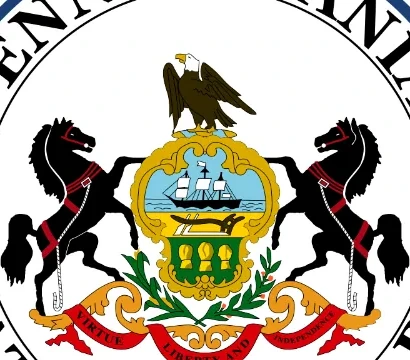
The motto appears on a ribbon at the bottom of Pennsylvania's coat of arms. The shield at the center displays three symbols: a ship at sea, a clay-red plow, and three golden sheaves of wheat. A bald eagle perches above as the crest, and two black horses stand on either side as supporters.
Pennsylvania's state flag displays the full coat of arms on a field of blue, placing the motto on the flag as well. The coat of arms has appeared on Pennsylvania's flags since 1799.
Pennsylvania State Motto Facts
- Pennsylvania's motto has three words: Virtue, Liberty, and Independence.
- It first appeared on the coat of arms designed by Philadelphia merchant Caleb Lownes in 1778.
- Lownes created the design while Philadelphia was serving as the seat of the Continental Congress.
- The Pennsylvania General Assembly authorized the coat of arms on state militia flags on April 9, 1799.
- In 1874, the legislature appointed a commission to standardize the coat of arms design.
- The commission's 1875 design was nearly identical to Lownes's original from 1778.
- The motto appears on a ribbon below the shield on both the coat of arms and the state flag.
Can You Match All 50 State Mottos?
Some questions show the original motto — Latin, Italian, Chinook — and ask which state it belongs to. Others give you the English translation and ask you to work backward. Both directions are harder than they look.
Take the State Mottos QuizQuick Answers
What is Pennsylvania's state motto?
What does Pennsylvania's state motto mean?
When did Pennsylvania adopt its state motto?
Where does Pennsylvania's state motto appear?
Who designed Pennsylvania's coat of arms with the motto?
Sources
Pennsylvania State Symbols


Show more (2)


Related States


Compare all 50 states by population, land area, statehood date, and more.
Themed lists - states sharing the same bird, oldest symbols, flags with bears, and more.
Side-by-side comparison of population, area, income, taxes, climate, and more.
Top 20 most common surnames per state - with origins, meanings, and heritage context. Is yours on the list?
You Might Also Like

Serial Killers by State
Alaska has the highest serial killer rate at 0.867 per 100,000 residents. Hawaii is lowest, and California has the highest raw count at 128.

Flag of Arkansas
Arkansas had no state flag until 1913. Its white diamond marks the only diamond-producing state. A fourth star marks Confederate membership.

Flag of Arizona
Arizona's flag was sketched on an envelope in 1910 for a rifle team. Adopted in 1917, it became law without the governor's signature.

Flag of Alaska
Benny Benson designed Alaska's flag at 13. Eight gold stars on navy blue, the Big Dipper pointing to Polaris, adopted in 1927 and kept at statehood.

Alabama State Flag
Alabama's crimson cross on white was adopted in 1895, likely modeled after the Confederate Battle Flag. The state's first flag was destroyed by a storm one month after raising.

Flag of California
Brown grizzly on white, adopted in 1911, traces to settler William Todd's handmade flag raised at Sonoma on June 14, 1846.

Rainwater Harvesting Laws by State
Rainwater harvesting is legal in all 50 states. Colorado caps residential storage at 110 gallons, while Utah allows up to 2,500 gallons.

Weird Laws in Arkansas
Weird laws in Arkansas include a repealed statewide tattoo ban, a 145-year-old pronunciation law, and a Sunday car sales rule that is still enforced today.