Oklahoma State Motto: Labor Omnia Vincit

US
Researched by USA Symbol Team

Fact-checked • Updated December 4, 2025

About Editor
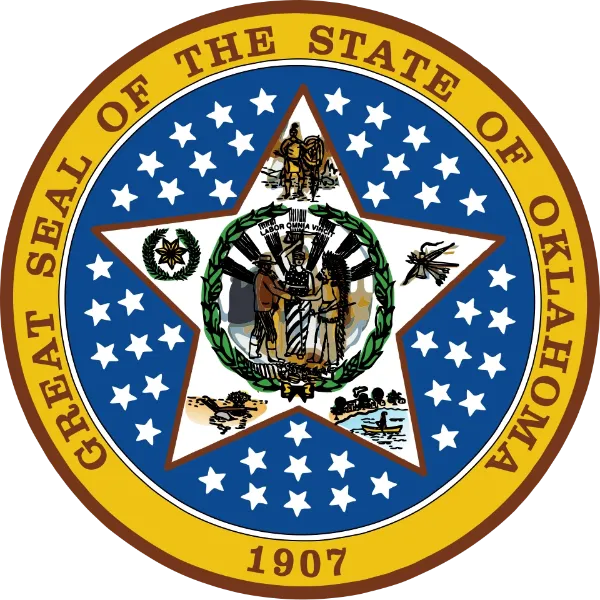
Oklahoma State Seal

OFFICIAL STATE SEAL

Latin 1907

"Labor Omnia Vincit"

Labor Conquers All Things

About This Motto

Oklahoma adopted Labor Omnia Vincit in 1907 state constitution. Latin phrase translates to Labor Conquers All Things. Frank Greer promoted motto for 1893 territorial seal. Gabe Parker combined territorial and Sequoyah seals in 1907. Oklahoma became 46th state November 16, 1907. Phrase comes from Roman poet Virgil's agricultural poem Georgics written 29 BC.

What the Motto Means

Labor Omnia Vincit translates to Labor Conquers All Things. Some sources render translation as Work Conquers All. Latin word labor means work, toil, or exertion. Omnia means all things. Vincit comes from vincere, to conquer or overcome. Phrase expresses triumph through persistent effort and hard work.

Original context from Virgil's Georgics, Book I, lines 145-146. Full Latin reads: Labor omnia vicit improbus. Complete phrase means steady work overcame all things or relentless toil conquered everything. Roman poet Virgil wrote Georgics 29 BC as four-book agricultural poem. Work supported Emperor Augustus Caesar's Back to the Land campaign encouraging Romans to become farmers. Poem described growth of agriculture from primitive beginnings.

Why choose agricultural poem? Oklahoma Territory economy relied heavily on farming. Settlers worked land acquired through land runs. Hard work essential for frontier survival. Phrase captured pioneer spirit of overcoming obstacles through labor. Frank Greer selected motto when designing territorial seal. Emphasized progress through industriousness rather than luck or divine intervention.

Motto appears in center of state seal within five-pointed star. Star contains central device from Oklahoma Territory seal including Latin words. Five rays of star hold symbols from Five Civilized Tribes. Cherokee, Chickasaw, Choctaw, Creek, and Seminole nations each have representation. Forty-five small stars surround central design. Stars denote existing states when Oklahoma joined Union as 46th state. Circular band reads Great Seal of the State of Oklahoma 1907.

Frank Greer & Territorial Seal 1893

Frank Greer's Background

Frank Hilton Greer born in Kansas to family of educators. Father Samuel Greer served as superintendent of Leavenworth schools and Kansas territorial superintendent of public instruction. Family moved to Winfield, Kansas in 1880 after Samuel's death. Eldest brother owned Winfield Courier newspaper. Frank worked for brother and desired own newspaper. Santa Fe Railway executives gave him inside information about future towns along railroad line. Greer planned to open newspaper at future Guthrie site.

Land Run April 22, 1889

Greer arrived in Unassigned Lands day before official opening. Concealed himself in freight car of telephone poles. Hid in woods until opening. Jumped off train at ten minutes after noon on April 22, 1889. Staked claim immediately. Became sooner by entering territory illegally. Started Daily State Capital newspaper with twenty-nine dollars. First issues printed in Winfield, Kansas before press arrived in Guthrie. Paper propagandized Guthrie's qualities to encourage outside investment.

Grand Seal Design March 10, 1893

Greer undertook promotion of Grand Seal for Oklahoma Territory 1893. Served in Territorial Legislature elected 1892. Second Territorial Legislature met in Guthrie January 1893. Greer's design described in legislature's House Bill 66. Design included Labor Omnia Vincit motto. Bill passed and seal became official March 10, 1893. Chronicles of Oklahoma documented seal adoption in 1957 article. Territory proudly proclaimed value of labor through motto.

Greer's Later Career

Daily State Capital served as Republican Party organ during Territorial Era. Competed with Leslie Niblack's Democratic Guthrie Daily Leader. Lost substantial revenue when Democratic Constitutional Convention named Niblack official printer in 1906. Newspaper remained prominent until capital moved from Guthrie to Oklahoma City June 1910. First wife died 1906. Moved to Tulsa 1911 and married Laura Leigh Hanson. Worked in real estate and oil investments. Died in Tulsa August 8, 1933.

Historical Background

  1. Oklahoma Statehood November 16, 1907

    Oklahoma Territory created May 2, 1890 from western Indian Territory and No Man's Land. Indian Territory remained separate until 1907. Congress passed Oklahoma Enabling Act June 16, 1906. Act required joint statehood for Oklahoma and Indian territories. Constitutional Convention opened in Guthrie November 20, 1906. William H. Murray elected convention chairman. Charles N. Haskell elected majority floor leader. Delegates completed draft March 15, 1907. Constitution put to vote September 17, 1907. Voters approved constitution 71 percent yes vote. President Theodore Roosevelt signed proclamation November 16, 1907. Oklahoma admitted as 46th state.

  2. Gabe Parker & State Seal Committee

    Gabriel Edward Parker born September 29, 1878 at Fort Towson in Choctaw Nation. Parker one-eighth Choctaw heritage. Graduated Spencer Academy 1894 and Henry Kendall College 1899. Served as teacher at Spencer Academy and Armstrong Academy. Attended 1906 Constitutional Convention as delegate. Designated chairman of seal committee. Earned nickname Great Seal Parker. Committee combined Grand Seal of Oklahoma Territory with Official Seal of proposed State of Sequoyah. Parker penciled sketch of seal ultimately approved. Design incorporated symbols from Five Civilized Tribes.

  3. Sequoyah Convention Context

    Indian Territory leaders held Sequoyah Convention August 1905 in Muskogee. Five Civilized Tribes sought separate statehood for Indian Territory. Convention drafted constitution and selected name Sequoyah honoring Cherokee who developed Cherokee alphabet. Voters in territory approved constitution November 7, 1905 by vote of 56,279 to 9,073. U.S. Congress refused to acknowledge Sequoyah Constitution due to party politics. President Roosevelt wanted joint statehood to avoid heavily Democratic Indian Territory joining Union separately. Hard work of Sequoyah Convention not entirely lost. Constitution served as basis for Oklahoma state constitution.

  4. Land Runs and Settlement

    Land Run of 1889 opened Unassigned Lands to settlement April 22. Approximately fifty thousand participants staked claims. Towns including Guthrie appeared overnight. Oklahoma Territory organized 1890. Cherokee Outlet opened September 16, 1893 adding over six million acres. Series of land runs continued through 1890s. Population grew rapidly as settlers claimed former Indian lands. Curtis Act of 1898 abolished tribal jurisdiction over Indian Territory. Allotment policy divided tribal lands into individual tracts. System deprived Native Americans of lands and resources.

Meaning & Significance Today

Motto appears on Great Seal of Oklahoma in center five-pointed star. Seal specified in Oklahoma Constitution Article VI, Section 35. Constitutional provision describes complete seal design including motto placement. State uses seal on official documents, government letterhead, and legal papers. Governor's office displays seal prominently. Motto continues as integral part of state identity since 1907 statehood.

Historical labor movement connection significant. Labor Omnia Vincit served as frequent motto within U.S. labor movement. American Federation of Labor and other early unions used phrase. Brotherhood of Sleeping Car Porters displayed motto on 1925 flag. International Union of Operating Engineers includes phrase on emblems. United Brotherhood of Carpenters and Joiners of America features motto. Oklahoma's adoption connected to broader working-class identity.

Oklahoma Constitution preamble echoed labor theme. Document stated purpose to promote our mutual welfare and happiness. Article 2, Section 32 declared perpetuities and monopolies contrary to genius of free government. Constitutional convention delegates emphasized importance of protecting workers. State labor statutes Title 40 developed comprehensive worker protections. Laws addressed wages, working conditions, and employee welfare.

Modern significance debated by historians. Some view motto as celebrating honest work and frontier self-reliance. Others note irony given displacement of Native Americans from lands. Tribal governments abolished to make way for settlement. Allotment policy broke up communal landholding. State's agricultural wealth built on lands taken from Five Civilized Tribes. Seal incorporates tribal symbols while motto celebrates labor that displaced them.

Cultural Context in Oklahoma

Agricultural Frontier Economy

Oklahoma Territory economy centered on agriculture. Wheat farming dominated western regions. Cotton grew in southern areas near Texas border. Cattle ranching spread across grasslands. Farming required intensive manual labor. Settlers broke prairie sod with plows. Built homes, barns, and fences from scratch. Drilled wells and dug irrigation ditches. Motto captured reality of frontier agricultural life where success depended on physical toil.

Five Civilized Tribes Displacement

Cherokee, Chickasaw, Choctaw, Creek, and Seminole forcibly removed from southeastern states 1830s-1840s. Tribes established governments and communities in Indian Territory. Operated schools, newspapers, and judicial systems. Curtis Act 1898 abolished tribal courts and governments. Dawes Commission negotiated allotment of tribal lands. Individual allotments replaced communal ownership. Federal policy systematically dismantled tribal sovereignty. Land opened to white settlement through runs and lotteries.

Republican vs. Democratic Politics

Oklahoma Territory generally Republican in politics. Frank Greer's newspaper supported Republican Party. Indian Territory leaned Democratic. Party politics influenced statehood debates. Southern Democrats feared Republican-controlled territories. Roosevelt's joint statehood plan aimed to balance political power. Constitutional Convention dominated by Democrats. Charles N. Haskell became first Democratic governor. Capital moved from Republican Guthrie to Democratic Oklahoma City in 1910.

Virgil's Influence on American Symbols

Many U.S. institutions adopted Latin mottoes from classical authors. Virgil particularly popular source for American symbols. His writings emphasized virtue of agricultural labor. Georgics promoted farming as noble occupation. Roman values of hard work and self-sufficiency appealed to American frontier mentality. Other states, cities, and organizations also used phrases from Virgil. Classical education exposed territorial leaders to Roman literature.

Current Law

Oklahoma Constitution Article VI, Section 35 governs state seal. Statute describes seal as five-pointed star with one ray directed upward. Center of star contains central device of seal of Territory of Oklahoma. Device includes words Labor Omnia Vincit. Upper left ray contains Cherokee Nation seal symbol (seven-pointed star partially surrounded by oak wreath). Ray directed upward contains Chickasaw Nation symbol (Indian warrior standing with bow and shield). Lower left ray holds Creek Nation emblem (sheaf of wheat and plow). Upper right ray displays Choctaw Nation symbol (tomahawk, bow, and three crossed arrows). Lower right ray shows Seminole Nation imagery (village with houses and factory beside lake with Indian paddling canoe).

Forty-five small stars grouped between rays divided into five clusters of nine stars each. Stars denote forty-five states of Union to which Oklahoma became 46th addition. Circular band surrounds whole device inscribed Great Seal of the State of Oklahoma 1907. Original constitutional provision unchanged since 1907. Motto never separately adopted outside seal description. Integration into seal statute provides legal basis for motto usage. State maintains motto as integral component of official seal.

Interesting Facts About the Motto

Fact 1 of 16

Frank Greer became a 'sooner' by illegally entering Oklahoma Territory one day before the official land run.

Sources & References

This article has been researched using authoritative sources to ensure accuracy and reliability. All information has been fact-checked and verified against official government records.

1
Oklahoma Historical Society - State Emblems
https://www.okhistory.org/publications/enc/entry?entry=ST020

Complete documentation of Oklahoma state symbols including motto adoption history, seal design, and Gabe Parker's role. • Accessed: December 31, 2025

2
Wikipedia - Labor omnia vincit
https://en.wikipedia.org/wiki/Labor_omnia_vincit

Historical context of phrase from Virgil's Georgics and usage by U.S. labor movement organizations. • Accessed: December 31, 2025

3
Oklahoma Historical Society - Greer, Frank Hilton
https://www.okhistory.org/publications/enc/entry.php?entry=GR026

Biographical information about Frank Greer including 1889 land run, newspaper founding, and 1893 seal promotion. • Accessed: December 31, 2025

4
National Archives - Oklahoma Statehood
https://www.archives.gov/legislative/features/oklahoma

Congressional records documenting Oklahoma's path to statehood, enabling act, and November 16, 1907 admission. • Accessed: December 31, 2025

5
Wikipedia - Gabe E. Parker
https://en.wikipedia.org/wiki/Gabe_E._Parker

Biography of Gabe Parker including 1906 Constitutional Convention role and state seal committee chairmanship. • Accessed: December 31, 2025

Accuracy Commitment: We strive to maintain accurate and up-to-date information. If you notice any errors or outdated information, please contact us.

Other Oklahoma Symbols

People Also Ask

What is Oklahoma's state motto?
Oklahoma's motto is 'Labor Omnia Vincit,' which translates to 'Labor Conquers All Things' in English.
When did Oklahoma adopt this motto?
The motto was incorporated into the territorial seal on March 10, 1893, and became part of the state seal in the 1907 Oklahoma Constitution.
Where does the motto come from?
The phrase comes from Roman poet Virgil's Georgics, Book I, written in 29 BC to support Emperor Augustus's campaign encouraging Romans to become farmers.
Who designed Oklahoma's territorial seal?
Frank Greer, a Guthrie newspaperman and territorial legislator, promoted the Grand Seal design that included the motto in 1893.
Who designed Oklahoma's state seal?
Gabe Parker, one-eighth Choctaw and chairman of the seal committee, led the design combining the territorial seal with elements from the Sequoyah Convention.
When did Oklahoma become a state?
Oklahoma became the 46th state on November 16, 1907, when President Theodore Roosevelt signed the proclamation.
What does the state seal show?
The seal features a five-pointed star with symbols from the Five Civilized Tribes (Cherokee, Chickasaw, Choctaw, Creek, Seminole), surrounded by forty-five stars representing existing states.
Is the motto officially adopted?
The motto exists within the state seal description in the Oklahoma Constitution but was never separately adopted as a standalone motto.
What other organizations use this motto?
The American Federation of Labor, Brotherhood of Sleeping Car Porters, and various labor unions have used the phrase historically.
What is the complete Latin phrase?
Virgil's complete phrase was 'Labor omnia vicit improbus,' meaning 'steady work overcame all things,' though Oklahoma uses the shortened version.