North Dakota State Motto: Liberty and Union, Now and Forever, One and Inseparable

US
Researched by USA Symbol Team

Fact-checked • Updated December 4, 2025

About Editor
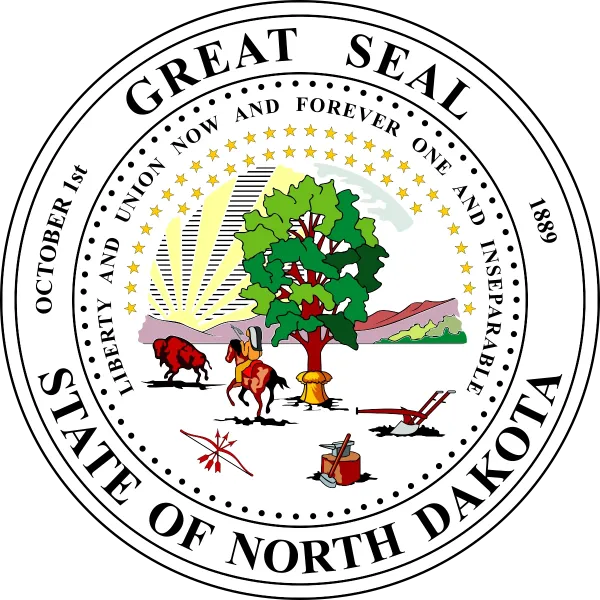
North Dakota State Seal

OFFICIAL STATE SEAL

English 1889

"Liberty and Union, Now and Forever, One and Inseparable"

About This Motto

North Dakota adopted Liberty and Union, Now and Forever, One and Inseparable in 1889 as state motto. English phrase comes from Daniel Webster's famous 1830 Senate speech. Dakota Territory had reversed phrase order. North Dakota corrected words when becoming state. State became 39th November 2, 1889.

What the Motto Means

Liberty and Union, Now and Forever, One and Inseparable is longest state motto in United States. English phrase emphasizes freedom and national unity. Liberty refers to personal freedom and democratic rights. Union means united states working together as one nation. Words assert that freedom and unity cannot exist separately. Both concepts remain permanently connected and inseparable.

Why this phrase? Daniel Webster spoke these words January 26-27, 1830 during Senate debate. The address defended national government against states' rights arguments. Webster argued against South Carolina Senator Robert Hayne. Debate covered federal land policy, tariffs, and state sovereignty. Webster's closing words became most famous quote in Senate history. These words served as rallying cry during Civil War.

Motto appears on North Dakota Great Seal. Design features American elm tree in open field. Three wheat bundles surround tree trunk. Plow, anvil and sledge appear right side. Bow with three arrows and Native American on horseback pursuing buffalo appear left. Forty-two stars arch above in half circle. Words Great Seal appear at top. State of North Dakota at bottom. October 1st on left, 1889 on right. Motto surrounds entire design in band.

Legislature never adopted motto separately from seal statute. Phrase exists within Great Seal description in state constitution. North Dakota Constitution Article 9, Section 2 specifies complete seal design including motto. Legal integration made adoption automatic. State uses motto on official documents and seals. Functions as official motto despite constitutional placement.

Historical Background

  1. Dakota Territory Formation 1861

    President James Buchanan signed bill creating Dakota Territory March 2, 1861. Original territory included present North Dakota, South Dakota, most of Montana, and most of Wyoming. Yankton in southeast corner served as first territorial capital. By 1868, territory consisted only of Dakotas. Population grew slowly until 1870s railroad expansion. Dakota Boom 1878-1886 brought massive settlement. Territory population jumped from 11,766 in 1870 to over 328,000 by 1890.

  2. Division Debate

    Northern and southern parts developed separately. Different railroad connections created distinct economies. Southern part connected to Sioux City, Iowa. Northern part linked to Minneapolis-Saint Paul. Territorial capital moved from Yankton to Bismarck 1883. Move angered southern residents. Territorial legislature submitted division question to voters November 1887. Results showed 37,784 favored division, 32,913 opposed. Republicans pushed for two states to gain four Senate seats instead of two.

  3. Omnibus Bill February 1889

    President Grover Cleveland signed Omnibus Bill February 22, 1889. Bill divided Dakota Territory in half. Also enabled Montana and Washington territories to seek statehood. Republicans controlled Congress after 1888 elections. Democrats agreed to deal excluding Democratic-leaning New Mexico. Bill required constitutional conventions starting July 4, 1889. Voters had to approve constitutions by October 1, 1889. North Dakota's constitutional convention met Bismarck. Fred Fancher led convention with large parade and celebration.

  4. Statehood November 2, 1889

    President Benjamin Harrison signed admission proclamations November 2, 1889. Harrison shuffled papers before signing to obscure which state entered first. Order remains unknown. North Dakota typically listed as 39th state due to alphabetical position. South Dakota listed as 40th. Both states admitted simultaneously. John Miller became North Dakota's first governor. Population exceeded 190,000. State constitution gave government officials limited power. Women gained right to vote in school elections.

Meaning & Significance Today

Motto appears on North Dakota Great Seal and state flag. Flag adopted 1911 based on military banner carried by troops in Spanish-American War 1898. Blue field features bald eagle grasping olive branch and arrows. Eagle holds ribbon reading E Pluribus Unum. Shield on eagle's breast shows thirteen stripes. Thirteen stars appear above in fan shape. Red scroll below bears words North Dakota. Design emphasizes patriotism and national unity.

State agencies use seal on official documents and correspondence. Secretary of State maintains custody. Governor displays seal at public events. You see design on government letterhead, licenses, and publications. Seal authenticates legal documents. Historical elements recall agricultural economy. Wheat bundles reference grain farming. Plow and anvil represent hard work and industry. Native American on horseback acknowledges indigenous people who lived on land first.

Webster's words gained renewed significance during Civil War. Union soldiers rallied around phrase. Northern states viewed motto as defense of federal union against secession. After war, phrase came to mean indivisible nation. North Dakota's adoption 1889 occurred during reconciliation period. Western states entering Union pledged loyalty to federal government. Motto declared commitment to national unity over state sovereignty.

Modern interpretation focuses on balance between individual liberty and collective union. Citizens value both personal freedom and participation in unified nation. Phrase reminds residents that democracy requires both elements. Students learn about Webster's debate in history classes. Teachers explain how Civil War settled constitutional questions Webster raised. Motto connects North Dakota to broader American tradition of federalism and unity.

Cultural Context in North Dakota

Webster-Hayne Debate Legacy

Daniel Webster's speech January 1830 addressed fundamental constitutional question. Could states nullify federal laws? Could they secede from Union? Webster argued Constitution created government made by people, not compact between states. Hayne countered that states retained sovereignty. Debate foreshadowed Civil War arguments. South Carolina attempted nullification 1832. Secession crisis erupted 1860-1861. Webster's position prevailed through Union victory. His phrase became shorthand for federal supremacy.

Civil War Era Significance

Webster died 1852 before Civil War began. His words took on prophetic quality during conflict. Union adopted Liberty and Union as rallying cry. Phrase appeared on banners and publications. Northern states invoked Webster's defense of national government. Confederate states emphasized states' rights position Hayne advocated. War settled debate Webster and Hayne began 1830. Federal government emerged supreme over individual states.

Republican Party Influence

North Dakota entered Union as Republican-dominated state. Party controlled territorial government. Republicans pushed for division to gain Senate seats. Two Dakota states meant four Republican senators. Single state would have produced only two. Republican Benjamin Harrison as president signed admission bill. First state governor John Miller was Republican. Party maintained control for decades after statehood.

Agricultural Identity

Dakota Boom brought farmers seeking free land under Homestead Act 1862. Wheat became primary crop. Giant farms stretched across prairies. Railroad companies marketed territory aggressively. Extolled region as ideal for agriculture. Settlers faced harsh winters and isolation. Farm communities developed strong cooperative spirit. Agricultural economy dominated until mid-20th century. Motto's emphasis on union reflected farmers' need for collective action.

Native American Displacement

Motto adopted during period of forced Native American removal. Sioux, Mandan, Hidatsa, and Arikara tribes lived in region for centuries. Treaties reduced tribal lands repeatedly. Reservation system confined indigenous peoples. State seal includes Native American on horseback pursuing buffalo. Image references disappearing way of life. Federal government promoted settlement on former tribal lands. Statehood represented triumph of agricultural settlers over indigenous inhabitants.

Current Law

North Dakota Constitution Article 9, Section 2 describes Great Seal including motto. Full text specifies tree in open field with three wheat bundles around trunk. Plow, anvil and sledge on right. Bow with three arrows and Native American on horseback pursuing buffalo toward setting sun on left. Forty-two stars arch above tree foliage in half circle. Motto Liberty and Union Now and Forever, One and Inseparable surrounds design. Words Great Seal at top, State of North Dakota at bottom. October 1st on left, 1889 on right. Seal measures two and one-half inches in diameter.

Original constitutional provision adopted 1889 remains unchanged. Legislature has not amended seal description. Motto exists as element of constitutional seal rather than separate statute. No standalone law designates phrase as official motto. Integration into constitution provides strongest legal foundation. Courts occasionally reference motto in opinions about state sovereignty and federal relations. State treats phrase as official motto despite constitutional placement within seal description.

Interesting Facts About the Motto

Fact 1 of 15

Liberty and Union, Now and Forever, One and Inseparable is the longest state motto in the United States.

Sources & References

This article has been researched using authoritative sources to ensure accuracy and reliability. All information has been fact-checked and verified against official government records.

1
ND Studies - State Symbols
https://www.ndstudies.gov/gr8/content/unit-iii-waves-development-1861-1920/lesson-4-alliances-and-conflicts/topic-4-statehood/section-3-state-symbols

Comprehensive history of North Dakota's motto, Daniel Webster's speech, and Dakota Territory's scrambled phrase. • Accessed: December 31, 2025

2
Wikipedia - Webster-Hayne Debate
https://en.wikipedia.org/wiki/Webster–Hayne_debate

Complete details on 1830 Senate debate between Webster and Hayne, historical context, and speech significance. • Accessed: December 31, 2025

3
U.S. Senate - Most Famous Senate Speech
https://www.senate.gov/artandhistory/history/minute/The_Most_Famous_Senate_Speech.htm

Senate Historical Office documentation of Webster's Second Reply to Hayne as most famous Senate speech. • Accessed: December 31, 2025

4
Wikipedia - Dakota Territory
https://en.wikipedia.org/wiki/Dakota_Territory

Territorial history, statehood process, and 1889 division into North and South Dakota. • Accessed: December 31, 2025

Accuracy Commitment: We strive to maintain accurate and up-to-date information. If you notice any errors or outdated information, please contact us.

Other North Dakota Symbols

People Also Ask

What is North Dakota's state motto?
North Dakota's state motto is Liberty and Union, Now and Forever, One and Inseparable.
When did North Dakota adopt this motto?
The motto was adopted in 1889 as part of the state constitution when North Dakota became a state.
Who created North Dakota's motto?
The phrase comes from Daniel Webster's Second Reply to Hayne speech delivered in the U.S. Senate on January 26-27, 1830.
What does the motto mean?
It emphasizes that personal liberty and national union are inseparably connected and must exist together forever.
When did North Dakota become a state?
North Dakota became the 39th state on November 2, 1889.
Did Dakota Territory use a different motto?
Dakota Territory used the same words but scrambled the order, reading Liberty and Union, one and inseparable, now and forever.
Where does the motto appear?
The motto appears on the North Dakota Great Seal surrounding the entire design in a band.
Why is this the longest state motto?
At thirteen words, Liberty and Union, Now and Forever, One and Inseparable is longer than any other state motto in the United States.
What was the Webster-Hayne debate about?
The 1830 debate covered federal land policy, tariffs, state sovereignty, and whether states could nullify federal laws or secede from the Union.
Is North Dakota the 39th or 40th state?
President Harrison shuffled the papers before signing, so the exact order is unknown, but North Dakota is typically listed as 39th due to alphabetical order.