New Jersey State Motto: Liberty and Prosperity
Liberty and Prosperity


Liberty and Prosperity
The motto appears on the state seal of New Jersey
- Motto
- Liberty and Prosperity
- Language
- English
- On the seal since
- 1777
- Appears on
- State Seal and Flag
New Jersey State Motto
New Jersey's official state motto is Liberty and Prosperity. The phrase appears on a scroll at the base of the state coat of arms, along with the year 1776 on the lower fold of the scroll. The arms have carried this motto since 1777.
The two figures supporting the shield on the coat of arms represent the motto directly. The figure on the left is Liberty, holding a staff topped with a Phrygian cap. The figure on the right is Ceres, the Roman goddess of agriculture, holding a cornucopia.
New Jersey State Motto Meaning
Liberty refers to political freedom — the right of citizens to govern themselves, free from British rule. It was the central cause of the American Revolution, and New Jersey adopted these words while the war was still being fought.
Prosperity refers to abundance and economic well-being. Ceres, the goddess of grain and harvest, gives the word a concrete image: a full cornucopia, overflowing with produce. Together, the two words describe what the new state was fighting for and hoping to build.
History of New Jersey's State Motto
On August 13, 1776, the Provincial Congress of New Jersey formed a committee to design a state seal. On October 3, 1776, the committee proposed a design with three plows on a shield, supported by Liberty and Ceres, with the motto Liberty and Property.
The committee asked Francis Hopkinson to oversee the artistic execution. Hopkinson, a New Jersey delegate and later a signer of the Declaration of Independence, commissioned the work from Pierre Eugène du Simitière, a Swiss artist based in Philadelphia. By the time du Simitière delivered the finished seal to the legislature in May 1777, the motto had changed from Liberty and Property to Liberty and Prosperity. The seal was formally adopted on October 3, 1777.
The phrase was never adopted as the official state motto through a separate act or resolution. It became the recognized motto because it is embedded in the seal description under New Jersey Statutes, Title 52, § 52:2-1. The coat of arms was revised slightly in 1928.
"Liberty and Prosperity" on the New Jersey State Seal
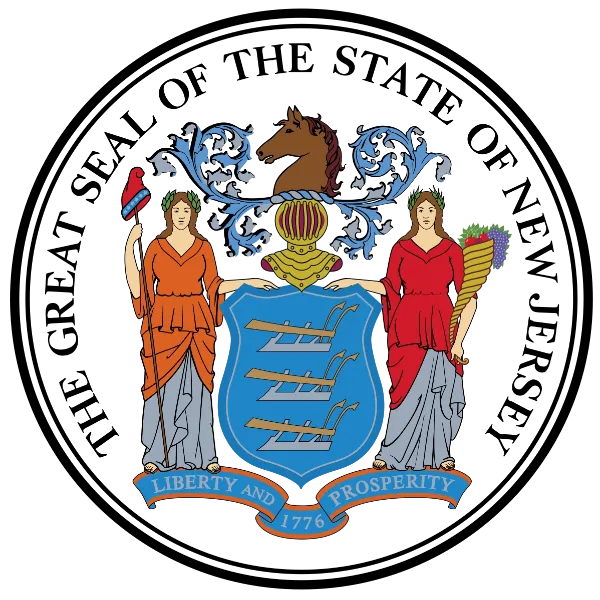
The motto runs along the upper fold of a blue and orange scroll at the base of the coat of arms. The year 1776 appears on the lower fold of the same scroll. Above the scroll, Liberty stands at left and Ceres at right, flanking a shield with three plows. A horse's head appears above the shield as the crest.
The coat of arms appears on both the state seal and the state flag. New Jersey's state flag, adopted on March 25, 1896, displays the full coat of arms on a buff-colored background — the color of the regiment uniforms worn by New Jersey troops during the American Revolution.
New Jersey State Motto Facts
- The motto has appeared on the New Jersey coat of arms since 1777, making it one of the oldest state mottoes in the country.
- The original 1776 proposal used the motto "Liberty and Property" — it was changed to "Liberty and Prosperity" before the seal was finalized in 1777.
- Swiss artist Pierre Eugène du Simitière designed the coat of arms at the request of Francis Hopkinson, a signer of the Declaration of Independence.
- The scroll on the seal carries two lines: "Liberty and Prosperity" on the upper fold and "1776" on the lower fold.
- Liberty holds a staff with a Phrygian cap, a symbol of freedom used by American patriots. Ceres holds a cornucopia representing agricultural abundance.
- The coat of arms appears on the state flag, adopted on March 25, 1896, against a buff background matching New Jersey Revolutionary War regimental colors.
Can You Match All 50 State Mottos?
Some questions show the original motto — Latin, Italian, Chinook — and ask which state it belongs to. Others give you the English translation and ask you to work backward. Both directions are harder than they look.
Take the State Mottos QuizQuick Answers
What is New Jersey's state motto?
What does "Liberty and Prosperity" mean?
When did New Jersey adopt its state motto?
What was New Jersey's original motto?
Sources
- NJ.gov — State Symbols
- New Jersey Statutes Title 52, § 52:2-1 (via NJ Legislature)
- Coat of Arms and Flag of New Jersey — Wikipedia
- New Jersey's State Seal — NJ Statehouse Tours
New Jersey State Symbols


Show more (2)


Related States


Compare all 50 states by population, land area, statehood date, and more.
Themed lists - states sharing the same bird, oldest symbols, flags with bears, and more.
Side-by-side comparison of population, area, income, taxes, climate, and more.
Top 20 most common surnames per state - with origins, meanings, and heritage context. Is yours on the list?
You Might Also Like

Concealed Carry Laws by State 2026
29 states allow permitless carry in 2026. Carry status, permit requirements, and reciprocity counts for all 50 states.

Abortion Laws by State 2026
13 states have total abortion bans after Dobbs. Gestational limits, waiting periods, and provider access for all 50 states.

Marijuana Laws by State 2026
24 states have legalized recreational marijuana in 2026. Possession limits, decriminalization, and medical access for all 50 states.

Red States, Blue States, and Swing States
24 states voted solidly Republican and 13 solidly Democratic in 2024. Pennsylvania, Michigan, and Wisconsin are the three closest swing states.

Electoral Votes by State
California leads all states with 54 electoral votes out of 538 total. See every state's electoral college count for the 2024 presidential elections.

Basilosaurus Whale
The Alabama state fossil is the Basilosaurus Whale (Basilosaurus cetoides), adopted in 1984. Fossils are found in southwest Alabama's Eocene deposits.

Petrified Wood
The Arizona state fossil is Petrified Wood (Araucarioxylon arizonicum), adopted in 1988. Fossil logs are found throughout Petrified Forest National Park.

Colorado State Colors
Official Colorado state colors are Blue and White, adopted in 1911. Blue reflects the sky and the columbine, white the Rocky Mountain snow.