New Hampshire State Motto: Live Free or Die
Live Free or Die


Live Free or Die
The motto appears on the state seal of New Hampshire
- Motto
- Live Free or Die
- Language
- English
- Adopted
- 1945
- Written by
- General John Stark, 1809
New Hampshire State Motto
New Hampshire's state motto is Live Free or Die. The New Hampshire General Court adopted it in 1945 under New Hampshire RSA 3:2. The phrase had existed for 136 years before it became the official motto.
The words come from a toast by General John Stark, New Hampshire's most celebrated soldier of the American Revolution. Stark wrote the full toast as: Live Free Or Die; Death Is Not The Worst of Evils.
New Hampshire State Motto Meaning
The phrase puts personal freedom above survival itself. Stark's toast said that dying is preferable to living without freedom, and that there are worse things than death — namely, living under tyranny.
For New Hampshire, the motto became a statement of independent character. The state consistently ranks among the least regulated in the country, and the motto appears on license plates, government buildings, and public documents as a persistent signal of that identity.
History of New Hampshire's State Motto
On July 31, 1809, General John Stark wrote a letter to veterans of the Battle of Bennington. He was in poor health and could not attend the 32nd anniversary reunion of the battle. In the letter, he included a toast to be read in his place: Live Free Or Die; Death Is Not The Worst of Evils.
Stark had led New Hampshire troops at the Battle of Bunker Hill in 1775 and commanded the American forces at the Battle of Bennington in Vermont on August 16, 1777. The Bennington victory halted the British advance from Canada and is considered one of the turning points of the Revolutionary War. Stark became known as the Hero of Bennington.
In 1945, New Hampshire was reportedly the last state in the country without an official motto. The General Court considered several candidates, including Strong and Steadfast as Our Granite Hills. The House voted 179 to 85 in favor of Live Free or Die; the Senate adopted it unanimously the same day.
In 1970, the state legislature required the motto to appear on all non-commercial license plates. That mandate led to a Supreme Court case in 1977. In Wooley v. Maynard, the Court ruled 7 to 2 that New Hampshire could not require motorists to display the motto if it conflicted with their personal beliefs — one of the few cases where a state motto directly produced a major First Amendment ruling.
"Live Free or Die" on the New Hampshire State Seal
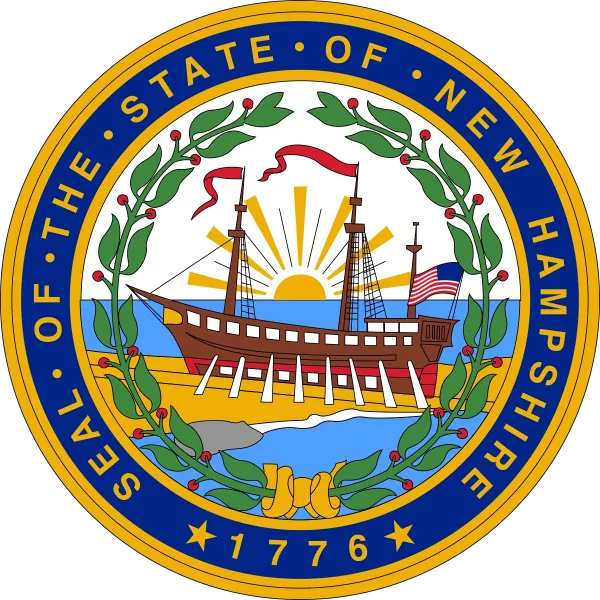
The motto appears on the Great Seal of New Hampshire alongside a ship under construction, a rising sun, and granite rocks. The seal is defined in New Hampshire RSA 3:1 and used on official state documents, government letterhead, and state buildings.
Since 1970, the motto has also appeared on all non-commercial New Hampshire license plates. It is one of the most recognized state license plates in the United States.
New Hampshire State Motto Facts
- General John Stark wrote "Live Free or Die" in a letter dated July 31, 1809 — 136 years before New Hampshire officially adopted it.
- The full toast reads: "Live Free Or Die; Death Is Not The Worst of Evils."
- The House vote to adopt the motto was 179 to 85; the Senate adopted it unanimously the same day.
- New Hampshire was reportedly the last U.S. state to adopt an official motto, doing so in 1945.
- Since 1970, the motto has appeared on all non-commercial New Hampshire license plates.
- In Wooley v. Maynard (1977), the U.S. Supreme Court ruled 7–2 that New Hampshire could not require motorists to display the motto if it conflicted with their beliefs.
Can You Match All 50 State Mottos?
Some questions show the original motto — Latin, Italian, Chinook — and ask which state it belongs to. Others give you the English translation and ask you to work backward. Both directions are harder than they look.
Take the State Mottos QuizQuick Answers
What is New Hampshire's state motto?
Who wrote "Live Free or Die"?
When did New Hampshire adopt "Live Free or Die" as its motto?
Why does "Live Free or Die" appear on New Hampshire license plates?
Sources
- State Motto | NH.gov
- New Hampshire RSA 3:2 — State Motto (Justia)
- "Live Free or Die" — New England Historical Society
- Wooley v. Maynard, 430 U.S. 705 (1977) — Justia
New Hampshire State Symbols


Show more (2)


Related States


Compare all 50 states by population, land area, statehood date, and more.
Themed lists - states sharing the same bird, oldest symbols, flags with bears, and more.
Side-by-side comparison of population, area, income, taxes, climate, and more.
Top 20 most common surnames per state - with origins, meanings, and heritage context. Is yours on the list?
You Might Also Like

Serial Killers by State
Alaska has the highest serial killer rate at 0.867 per 100,000 residents. Hawaii is lowest, and California has the highest raw count at 128.

Flag of Arkansas
Arkansas had no state flag until 1913. Its white diamond marks the only diamond-producing state. A fourth star marks Confederate membership.

Flag of Arizona
Arizona's flag was sketched on an envelope in 1910 for a rifle team. Adopted in 1917, it became law without the governor's signature.

Flag of Alaska
Benny Benson designed Alaska's flag at 13. Eight gold stars on navy blue, the Big Dipper pointing to Polaris, adopted in 1927 and kept at statehood.

Alabama State Flag
Alabama's crimson cross on white was adopted in 1895, likely modeled after the Confederate Battle Flag. The state's first flag was destroyed by a storm one month after raising.

Flag of California
Brown grizzly on white, adopted in 1911, traces to settler William Todd's handmade flag raised at Sonoma on June 14, 1846.

Rainwater Harvesting Laws by State
Rainwater harvesting is legal in all 50 states. Colorado caps residential storage at 110 gallons, while Utah allows up to 2,500 gallons.

Weird Laws in Arkansas
Weird laws in Arkansas include a repealed statewide tattoo ban, a 145-year-old pronunciation law, and a Sunday car sales rule that is still enforced today.