Nevada State Motto: All for Our Country

US
Researched by USA Symbol Team

Fact-checked • Updated December 4, 2025

About Editor
Nevada State Seal

OFFICIAL STATE SEAL

English 1866

"All for Our Country"

All for Our Country

About This Motto

Nevada adopted All for Our Country on February 24, 1866. Legislature replaced territorial Latin motto Volens et Potens (Willing and Able). Nevada became 36th state October 31, 1864 during Civil War. President Abraham Lincoln needed support for reelection and 13th Amendment. No historical records document why specific phrase chosen. Commonly confused with Battle Born nickname on state flag.

What the Motto Means

All for Our Country expresses complete loyalty and allegiance to United States. Plain English wording differs from Latin mottoes used by most states. Phrase declares Nevada would give everything to support nation. Former state archivist Guy Rocha explained motto essentially states Nevada first and foremost would give all its allegiance to United States. Context matters greatly for understanding motto choice.

Why such strong declaration? Nevada gained statehood October 31, 1864 during Civil War. Union battled Confederacy over secession and slavery. Nation divided and loyalty questioned across territories. Lincoln needed states committed to preserving Union. Nevada's entry gave Republicans crucial support in Congress and electoral college. Motto sent clear message to wounded nation only months after Lee surrendered at Gettysburg.

Previous territorial motto used Latin. Volens et Potens meant Willing and Able. Territorial seal adopted 1861 featured this phrase. Latin conveyed commitment to Union and mineral wealth to sustain it. English replacement in 1866 made allegiance statement more direct and accessible. Plain language eliminated any ambiguity about Nevada's position. State wanted no confusion about loyalty.

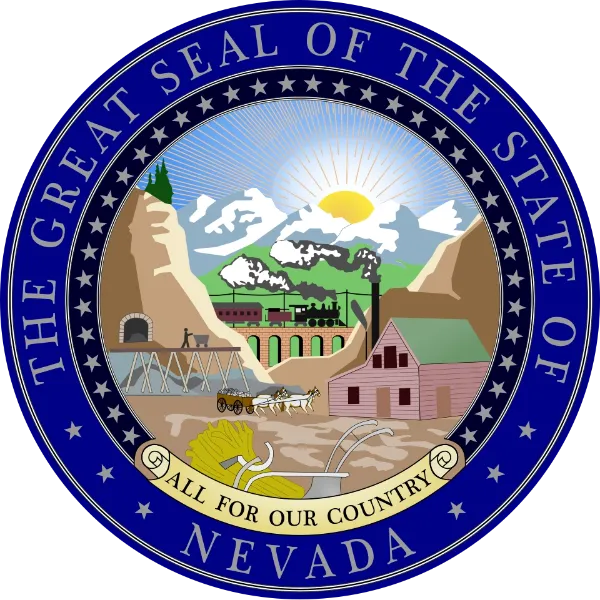
Motto appears on Great Seal of Nevada near bottom on yellow band. Thirty-six stars surround motto signifying Nevada as 36th state to join Union. Seal shows mining and agricultural scenes. Quartz mill and tunnel appear at base of mountains. Miner pushes ore cart while team loads ore for mill. Plow, wheat sheaf, and sickle sit in foreground. Railroad train passes mountain gorge with telegraph line. Snow-capped peaks rise in background with sun rising in east.

1866 Legislature & Seal Adoption

No Documented Source

No historical records explain why All for Our Country chosen. Legislature kept no proceedings or discussions about seal design decisions. Committee deliberations lost to history. State archivist Jeff Kintop noted founding fathers pushed around number of ideas for mottoes during 1863 Constitutional Convention. Among suggestions was decidedly political message: The Union Must and Shall Be Preserved. More pointed statement never adopted. Selection probably had as much to do with when chosen as anything else.

February 24, 1866 Legislative Action

Second session of Nevada Legislature officially adopted seal description February 24, 1866. Law replaced territorial motto Volens et Potens with All for Our Country. Design formalized Nevada's mineral resources featuring silver miner and team moving ore from mountain. Quartz mill stands before another mountain. Transportation and communication shown by train steaming across background with telegraph poles. Agriculture indicated by wheat sheaf, sickle, and plow. Natural beauty captured by sun rising over snow-capped peaks.

1864 Constitutional Convention

Constitutional Convention in 1864 adopted description of features for Nevada's Great Seal. Convention passed resolution authorizing Secretary of Territory to procure state seal after constitution ratification. Unfortunately Convention failed to incorporate action in constitution itself. Being omitted from approved constitution, Convention's actions had no binding legal effect. Legislature needed to act in 1866 to legally establish state seal and motto.

Territorial Seal History

Nevada Territory created March 2, 1861 by President James Buchanan. First Territorial Legislature convened October 1, 1861 in Carson City. Territorial Secretary Orion Clemens presented seal design to legislature October 7, 1861. After debate and revisions, design approved November 28, 1861. Governor James W. Nye signed into law following day. Design featured quartz mill, miner with U.S. flag, and Latin motto Volens et Potens. Seal intended to express Nevada's commitment to Union and natural wealth.

Historical Background

  1. Nevada Statehood October 31, 1864

    President Abraham Lincoln admitted Nevada to Union October 31, 1864. Territory had only 40,000 residents, considerably short of 60,000 normally required for statehood. Lincoln anxious to have support of Republican-dominated Nevada Territory for reelection. 1864 presidential election scheduled November 8. Lincoln also needed votes for proposed 13th Amendment banning slavery. Throughout administration Lincoln appointed territorial officials who were strong Republicans. Knew he could count on congressmen and citizens of new state to support him.

  2. Constitution Telegraph

    Constitutional Convention met Carson City July 4-28, 1864. Public vote on constitution held September 7, 1864. Governor James W. Nye frustrated previous attempts to send constitution via overland mail and sea had failed by October 24. Full text sent by telegraph October 26 at cost of $4,303.27. Most costly telegraph on file at time for single dispatch. Transmission took more than seven hours. Response from Washington came October 31, 1864: the pain is over, the child is born, Nevada this day was admitted into the Union.

  3. Comstock Lode Discovery

    1859 discovery of incredibly large and rich silver deposits at Virginia City rapidly made region important and wealthy. Inexpert miners initially developed placer gold deposits. Complained about blue-gray material clogging gold sluices. More experienced miners realized material was actually rich silver ore. Soon discovered massive underground silver deposit called Comstock Lode. Nevada's mineral wealth gained importance during Civil War. Both sides needed wealth to pay for battle expenses. Silver from Nevada worth hundreds of millions of dollars boosted Union war effort.

  4. Civil War Service

    Most Nevadans favored Northern cause during Civil War. Territory mustered 1,200 men to fight for Union. May 1863 Nevada raised 1st Battalion Nevada Volunteer Cavalry. Summer 1864 brought 1st Battalion Nevada Volunteer Infantry. Volunteer groups served garrisoning frontier posts and participating in scouting assignments. Nevada civilians supported sick and wounded soldiers. Women volunteered and fundraised for relief agencies like United States Sanitary Commission. Confederate forces never posed serious threat of territorial seizure. Nevada remained firmly in Union control for war duration.

Meaning & Significance Today

Motto appears on Great Seal used for all official state business. Secretary of State affixes seal to certified documents. Seal measures no more than 2¾ inches in diameter. Governor maintains custody though Secretary of State has access for official acts. Nevada Constitution Article V, Section 15 designates governor as keeper of seal. Legislature clarified custody issues in 1875 statute. No constitutional amendment ever passed to transfer ultimate custody.

Common confusion exists between motto and nickname. Battle Born appears on Nevada state flag as nickname. Many people mistake Battle Born as official state motto. Thomas Fitch, who later represented Nevada in Congress, credited with coining term during 1864 Constitutional Convention. Former state archivist Guy Rocha noted Battle Born about as old as All for Our Country. Confusion probably just as old. Nickname commemorates Nevada's entry during Civil War. State admitted while conflict still raged.

Nevada flag went through several versions. Early flag from 1905 to 1915 had silver and gold stars with words silver, Nevada, and gold emblazoned on dark blue field. Design honored state's mining industry. Current flag adopted 1991 features Battle Born inscription. Blue field shows sagebrush wreath surrounding silver star with Nevada written above. Flag design contributes to motto confusion since Battle Born prominently displayed.

Motto choice reflected urgent circumstances of 1860s statehood. Nevada's rapid admission served Lincoln's political needs. State delivered three electoral votes in November 1864 election. Helped secure Lincoln's reelection. Nevada supported passage of 13th Amendment ending slavery. Constitutional context shaped motto selection. Phrase communicated unwavering loyalty during national crisis. Modern Nevada maintains historical motto despite changed circumstances.

Cultural Context in Nevada

Mining Boom Economy

Virginia City mushroomed overnight after Comstock Lode discovery. Population reached 30,000 people in heyday with 106 saloons. Mark Twain inhabited Virginia City from 1862 until 1864. Vividly depicted wild Nevada days in Roughing It published 1872. Mining created instant wealth but harsh conditions. Nevada's economy tied directly to mineral extraction. Quartz mills processed silver ore. Miners worked dangerous underground tunnels. Territory's value to Union came primarily from silver production funding war effort.

Republican Political Dominance

Lincoln appointed strong Republicans to territorial positions. Territory leaned heavily Republican during Civil War era. Political alignment crucial to statehood timing. Democrats opposed rapid admission fearing Republican advantage. Lincoln pushed through despite population shortfall. Statehood gave Republicans additional congressional seats and electoral votes. Political calculations drove admission more than democratic principles or population requirements. Nevada's loyalty never questioned during war period.

Civil War Aftermath

Nation healing from devastating conflict when motto adopted. Over 600,000 Americans died in Civil War. Reconstruction era began as states rejoined Union. Loyalty oaths required in former Confederate states. Nevada's All for Our Country motto contrasted with Southern resistance. State positioned itself as reliable Union supporter. Motto reinforced Nevada's wartime commitment. Historical context of 1866 adoption inseparable from Civil War trauma and reunion challenges.

Frontier Settlement Patterns

Nevada Territory attracted fortune-seekers and adventurers. Population consisted largely of single men working mines. Few families compared to agricultural territories. Transient population moved with mining strikes. Virginia City, Carson City, and other towns grew rapidly. Infrastructure developed to support mining operations. Railroads connected mines to markets. Telegraph lines enabled rapid communication with eastern states. Nevada's settlement pattern differed dramatically from traditional westward expansion based on farming.

Current Law

Nevada Revised Statutes Title 19, Chapter 235 governs state emblems. Section 235.010 describes Great Seal of State of Nevada. Statute specifies design must include motto All for Our Country encircling whole group of imagery. Thirty-six stars and motto must surround central scenes. Outer circle must contain words The Great Seal of the State of Nevada. Nevada engraved at base of seal separated from other words by two groups of three stars each.

Seal size limited to maximum 2¾ inches in diameter. Governor designated as seal keeper. Secretary of State has access to seal at all times. May use seal in verification of all official acts. Unauthorized use of seal classified as misdemeanor. Law specifies exact design elements including mountains, quartz mill, tunnel, miner, ore cart, team, agricultural implements, railroad train, telegraph line, snow-capped peaks, and rising sun. Legislature amended statute in 1969 to make legal description conform to actual seal features. Colors formally defined in 1999 as primarily yellow and blue.

Interesting Facts About the Motto

Fact 1 of 16

Nevada is the only state with an English motto expressing complete national allegiance.

Sources & References

This article has been researched using authoritative sources to ensure accuracy and reliability. All information has been fact-checked and verified against official government records.

1
Wikipedia - Seal of Nevada
https://en.wikipedia.org/wiki/Seal_of_Nevada

Complete history of Nevada seal from 1861 territorial design through 1866 state adoption, including motto changes. • Accessed: December 31, 2025

2
Wikipedia - Nevada in the American Civil War
https://en.wikipedia.org/wiki/Nevada_in_the_American_Civil_War

Nevada's role during Civil War including volunteer forces, statehood timing, and Lincoln's political calculations. • Accessed: December 31, 2025

3
History.com - Nevada Admitted as 36th State
https://www.history.com/this-day-in-history/october-31/the-u-s-congress-admits-nevada-as-the-36th-state

October 31, 1864 statehood admission, Comstock Lode discovery, and telegraph transmission of constitution. • Accessed: December 31, 2025

4
Wikipedia - Nevada
https://en.wikipedia.org/wiki/Nevada

Comprehensive Nevada history including territorial period, statehood process, and Battle Born nickname origin. • Accessed: December 31, 2025

Accuracy Commitment: We strive to maintain accurate and up-to-date information. If you notice any errors or outdated information, please contact us.

Other Nevada Symbols

People Also Ask

What is Nevada's state motto?
Nevada's motto is 'All for Our Country,' adopted on February 24, 1866.
Is 'Battle Born' Nevada's motto?
No, 'Battle Born' is Nevada's nickname that appears on the state flag, not the official motto.
When did Nevada become a state?
Nevada became the 36th state on October 31, 1864, during the Civil War.
Why did Nevada adopt this motto?
No historical records document the specific reason, but the motto expressed Nevada's complete loyalty to the Union during the Civil War era.
What was Nevada's territorial motto?
The territorial motto was 'Volens et Potens,' Latin for 'Willing and Able,' adopted in 1861.
Why did Lincoln rush Nevada's statehood?
Lincoln needed support for his 1864 reelection and votes for the proposed 13th Amendment banning slavery.
Did Nevada meet population requirements for statehood?
No, Nevada had only 40,000 residents, well below the normal 60,000 requirement, but Congress expedited admission.
Who coined the term 'Battle Born'?
Thomas Fitch, who later represented Nevada in Congress, coined the term during the 1864 Constitutional Convention.
Where does the motto appear?
The motto appears on the Great Seal of Nevada on a yellow band surrounded by 36 stars.
What other motto was considered?
The 1863 Constitutional Convention considered the more political 'The Union Must and Shall Be Preserved.'