Nebraska State Motto: Equality Before the Law
Equality Before the Law


Equality Before the Law
The motto appears on the state seal of Nebraska
- Motto
- Equality Before the Law
- Language
- English
- Adopted
- June 14, 1867
- Proposed by
- Isaac Wiles
Nebraska State Motto
Nebraska's state motto is Equality Before the Law. It was adopted on June 14, 1867, under H.R. 41 and signed by Governor David Butler, just 105 days after Nebraska became the 37th state on March 1, 1867.
The motto is in plain English, which is less common among U.S. state mottos — most states use Latin. Nebraska's choice reflected an immediate and urgent political reality: the state had just been required by Congress to guarantee equal voting rights as a condition of admission.
Nebraska State Motto Meaning
Equality before the law means that every person is subject to the same laws and entitled to the same legal protections, regardless of race, background, or status. No one stands above the law, and no one is excluded from its protection.
In 1867, this was not a settled principle in the United States. The phrase had a specific, contested meaning: it was used by Republicans pressing to extend legal equality to Black Americans after the Civil War. Nebraska's adoption of the phrase placed the state squarely in that debate.
History of Nebraska's State Motto
Nebraska first applied for statehood in 1866. Congress rejected the application because the proposed Nebraska constitution restricted voting to White men. On February 8, 1867, Congress passed an admission act requiring Nebraska to guarantee that voting rights could not be denied on the basis of race or color. Nebraska met the condition and became the 37th state on March 1, 1867.
Three and a half months later, the state legislature took up the question of a state seal. Isaac Wiles, a House member from Plattsmouth in Cass County, proposed the motto. He considered two options: Equal Rights for All and Equality Before the Law. He consulted Elmer S. Dundy, an associate justice of the Nebraska Supreme Court, who preferred Equality Before the Law. Wiles included it in his seal proposal.
The phrase had an immediate source: Nebraska Republicans had adopted a platform on April 12, 1866, declaring their party owed a duty to secure liberty and equality before the law to all men. Wiles was likely drawing directly from that language. Governor David Butler signed H.R. 41 into law on June 14, 1867, establishing the state seal and its motto.
"Equality Before the Law" on the Nebraska State Seal
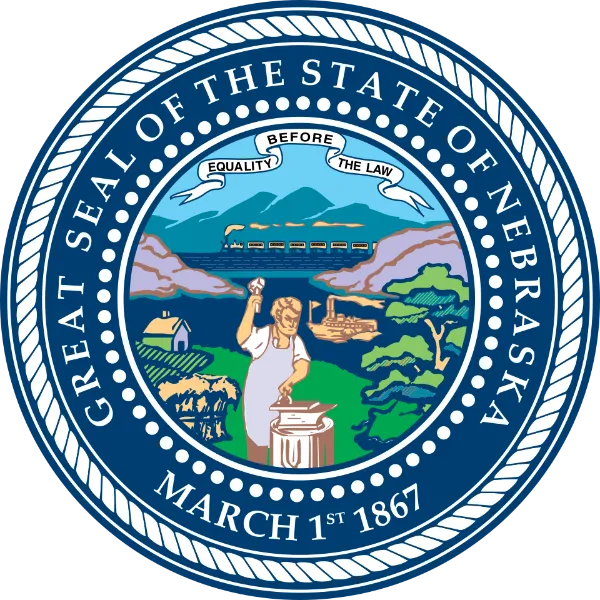
The motto appears in capital letters around the upper arc of the Nebraska state seal. Below the motto, the seal shows a blacksmith at his anvil, a steamboat on the Missouri River, a settler's cabin, sheaves of wheat, and a train heading west toward the Rocky Mountains. The outer ring reads: Great Seal of the State of Nebraska, March 1st, 1867.
The Nebraska state flag was created in 1925 and officially adopted by statute in 1963. It shows the state seal in gold and silver on a blue field, with the motto visible in the upper arc of the seal.
Nebraska State Motto Facts
- Nebraska's motto is in English — most U.S. states use Latin for their official mottos.
- It was adopted on June 14, 1867, just 105 days after Nebraska became the 37th state on March 1, 1867.
- Isaac Wiles proposed the motto. He consulted Supreme Court Justice Elmer Dundy, who chose it over the alternative "Equal Rights for All."
- Congress required Nebraska to remove racial voting restrictions as a condition of statehood in 1867 — the political context that shaped the motto.
- The phrase came from the Nebraska Republican platform of April 12, 1866, which pledged to secure "liberty and equality before the law to all men."
- The motto appears in capital letters in the upper arc of the state seal, above scenes of a blacksmith, steamboat, settler's cabin, and westbound train.
Can You Match All 50 State Mottos?
Some questions show the original motto — Latin, Italian, Chinook — and ask which state it belongs to. Others give you the English translation and ask you to work backward. Both directions are harder than they look.
Take the State Mottos QuizQuick Answers
What is Nebraska's state motto?
What does Nebraska's motto mean?
When did Nebraska adopt its state motto?
Who proposed Nebraska's state motto?
Why did Nebraska choose this motto?
Where does Nebraska's motto appear?
Sources
- Nebraska State Historical Society — How 'Equality Before the Law' Became Our State Motto
- Nebraska State Historical Society — Thoughts on the Origin of Nebraska's State Motto
- Seal of Nebraska — Wikipedia
Nebraska State Symbols


Show more (2)


Related States


Compare all 50 states by population, land area, statehood date, and more.
Themed lists - states sharing the same bird, oldest symbols, flags with bears, and more.
Side-by-side comparison of population, area, income, taxes, climate, and more.
Top 20 most common surnames per state - with origins, meanings, and heritage context. Is yours on the list?
You Might Also Like

Basilosaurus Whale
The Alabama state fossil is the Basilosaurus Whale (Basilosaurus cetoides), adopted in 1984. Fossils are found in southwest Alabama's Eocene deposits.

Petrified Wood
The Arizona state fossil is Petrified Wood (Araucarioxylon arizonicum), adopted in 1988. Fossil logs are found throughout Petrified Forest National Park.

Colorado State Colors
Official Colorado state colors are Blue and White, adopted in 1911. Blue reflects the sky and the columbine, white the Rocky Mountain snow.

Alabama State Colors
Crimson and white are Alabama's traditional state colors, taken from the 1895 state flag's wide saltire cross on a white field.

Real California Laws You Won't Believe
Strange laws in California include a Carmel permit required for wearing high heels and a Chico ordinance that fines nuclear bomb detonation just $500.

Dating to Engagement Time by State 2026
Utah couples get engaged after just 15 months of dating, the fastest in the U.S. Massachusetts averages 36 months. National average is 25 months.

Which US State Capitals Are Named After Presidents?
Only 4 of 50 U.S. state capitals are named after presidents: Lincoln, Madison, Jackson, and Jefferson City. Washington state's capital is Olympia.

Minimum Wage by State 2026
Washington leads at $16.66; 20 states remain at the $7.25 federal minimum in 2026. Rates, tipped wages, and next increases for all 50 states.