Montana State Motto: Oro y Plata
Oro y Plata


Oro y Plata
The motto appears on the state seal of Montana
- Motto
- Oro y Plata
- Language
- Spanish
- Translation
- Gold and Silver
- Adopted
- February 9, 1865
Montana State Motto
Montana's state motto is Oro y Plata, a Spanish phrase meaning Gold and Silver. It was adopted by the Montana Territorial Legislature on February 9, 1865, and formally confirmed by the state legislature on March 2, 1893, after Montana achieved statehood.
The motto connects directly to Montana's nickname, the Treasure State. Gold was discovered in Montana in 1862, and silver followed. The motto captures the two metals that defined the territory's early economy.
Translation of "Oro y Plata"
Oro is Spanish for gold. Y means and. Plata is Spanish for silver. Together: Gold and Silver.
Spanish mining vocabulary was widely used throughout the American West by the 1860s. Words like placer, bonanza, and plata were part of everyday mining life, carried north from California and Nevada by prospectors who moved from one gold field to the next.
Montana State Motto Meaning
The motto names what brought most people to Montana Territory: precious metals. Gold was discovered in Grasshopper Creek near Bannack in 1862, triggering a rush that quickly populated an otherwise remote wilderness. Silver followed, and Montana's mines became some of the most productive in the country.
Choosing gold and silver as the state's defining phrase placed Montana's identity squarely in its natural resources. The motto makes no claim about government, courage, or ideals — it says what the land contains.
History of Montana's State Motto
Montana Territory was established on May 26, 1864. That winter, the First Territorial Legislative Assembly met in Bannack. Francis McGee Thompson, a representative from Beaverhead County, proposed the motto and the design for the territorial seal.
Thompson's original draft included a grammatical error: he wrote Oro el Plata. In Spanish, el is a masculine definite article meaning the, not a conjunction. The correct word to connect two nouns is y, meaning and. The error was caught and corrected before Territorial Governor Sidney Edgerton signed the bill into law on February 9, 1865.
Montana became the 41st state on November 8, 1889. The state legislature formally readopted the motto on March 2, 1893, as part of establishing the official state seal. G.R. Metten executed the first engraved state seal that year and was paid $20 for the work.
"Oro y Plata" on the Montana State Seal
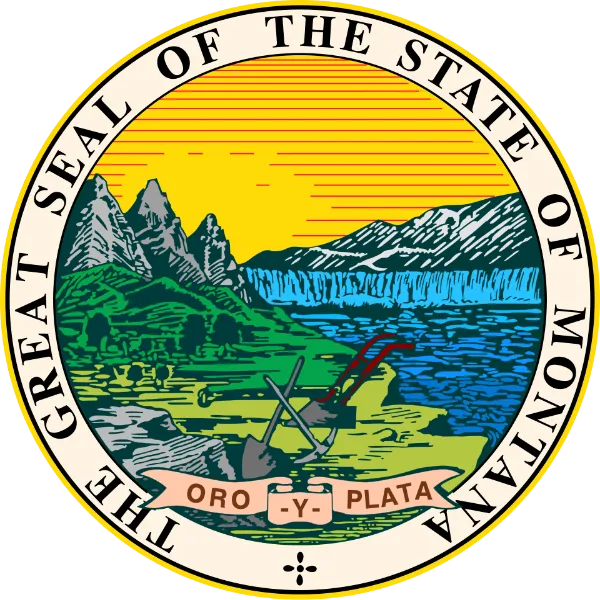
The motto appears on a ribbon at the bottom of the Montana state seal. The seal's central design shows a plow, a miner's pick, and a shovel in the foreground — representing agriculture and mining. Behind them, the Great Falls of the Missouri River runs across the middle ground, with mountains and a rising sun in the background.
Montana's state flag was adopted in 1905. It shows the state seal on a deep blue background. In 1981, the legislature added the word MONTANA in gold letters above the seal. The motto is visible on the ribbon within the seal on the flag.
Montana State Motto Facts
- "Oro y Plata" means "Gold and Silver" in Spanish.
- It was adopted on February 9, 1865, by the Montana Territorial Legislature — 24 years before Montana became a state.
- The original draft mistakenly used "Oro el Plata" — "el" is an article, not a conjunction. It was corrected to "y" (and) before signing.
- Francis McGee Thompson, a representative from Beaverhead County, proposed the motto at the First Territorial Legislature in Bannack.
- Gold was discovered in Montana in 1862 at Grasshopper Creek near Bannack, launching the rush that populated the territory.
- G.R. Metten engraved the first official state seal in 1893 and was paid $20.
Can You Match All 50 State Mottos?
Some questions show the original motto — Latin, Italian, Chinook — and ask which state it belongs to. Others give you the English translation and ask you to work backward. Both directions are harder than they look.
Take the State Mottos QuizQuick Answers
What is Montana's state motto?
What does "Oro y Plata" mean?
Why is Montana's motto in Spanish?
When did Montana adopt its state motto?
Who created Montana's state motto?
Where does Montana's motto appear?
Sources
Montana State Symbols


Show more (2)


Related States


Compare all 50 states by population, land area, statehood date, and more.
Themed lists - states sharing the same bird, oldest symbols, flags with bears, and more.
Side-by-side comparison of population, area, income, taxes, climate, and more.
Top 20 most common surnames per state - with origins, meanings, and heritage context. Is yours on the list?
You Might Also Like

Serial Killers by State
Alaska has the highest serial killer rate at 0.867 per 100,000 residents. Hawaii is lowest, and California has the highest raw count at 128.

Flag of Arkansas
Arkansas had no state flag until 1913. Its white diamond marks the only diamond-producing state. A fourth star marks Confederate membership.

Flag of Arizona
Arizona's flag was sketched on an envelope in 1910 for a rifle team. Adopted in 1917, it became law without the governor's signature.

Flag of Alaska
Benny Benson designed Alaska's flag at 13. Eight gold stars on navy blue, the Big Dipper pointing to Polaris, adopted in 1927 and kept at statehood.

Alabama State Flag
Alabama's crimson cross on white was adopted in 1895, likely modeled after the Confederate Battle Flag. The state's first flag was destroyed by a storm one month after raising.

Flag of California
Brown grizzly on white, adopted in 1911, traces to settler William Todd's handmade flag raised at Sonoma on June 14, 1846.

Rainwater Harvesting Laws by State
Rainwater harvesting is legal in all 50 states. Colorado caps residential storage at 110 gallons, while Utah allows up to 2,500 gallons.

Weird Laws in Arkansas
Weird laws in Arkansas include a repealed statewide tattoo ban, a 145-year-old pronunciation law, and a Sunday car sales rule that is still enforced today.