Missouri State Motto: Salus Populi Suprema Lex Esto
Salus Populi Suprema Lex Esto


Salus Populi Suprema Lex Esto
The motto appears on the state seal of Missouri
- Motto
- Salus Populi Suprema Lex Esto
- Language
- Latin
- Translation
- Let the Welfare of the People Be the Supreme Law
- Adopted
- January 11, 1822
Missouri State Motto
Missouri's state motto is Salus Populi Suprema Lex Esto, a Latin phrase meaning Let the Welfare of the People Be the Supreme Law. It was adopted as part of the Missouri state seal on January 11, 1822, about five months after Missouri became the 24th state on August 10, 1821.
The phrase comes directly from Cicero's De Legibus (On Laws), Book III. Missouri is one of the few U.S. states whose motto quotes a specific classical author and work.
Translation of "Salus Populi Suprema Lex Esto"
Salus means welfare, safety, or wellbeing. Populi is the genitive of populus, meaning of the people. Suprema means supreme or highest. Lex means law. Esto is an imperative form of to be, translated as let it be or shall be.
Together: Let the welfare of the people be the supreme law. The phrase states a governing principle: above all other laws and interests, the wellbeing of citizens comes first.
Missouri State Motto Meaning
The motto sets a standard for government: the welfare of the people is the highest obligation. It does not describe courage or military strength, as many state mottos do. It describes a duty.
In Cicero's original text, the full passage reads: Ollis salus populi suprema lex esto, where ollis is an archaic Latin dative meaning for them. Cicero was writing about the obligations of military commanders. Missouri dropped ollis, turning a conditional instruction into a universal statement.
That small change shifts the meaning significantly. Cicero's version applied to a specific group. Missouri's version applies without qualification: the welfare of the people is the supreme law, for everyone.
History of Missouri's State Motto
Missouri was admitted to the Union on August 10, 1821, as the 24th state. The Missouri General Assembly began work on a state seal almost immediately. Judge Robert William Wells designed the seal, and the Assembly adopted it on January 11, 1822.
Wells drew the motto from Cicero's De Legibus (On Laws), Book III, a work on Roman law and government. Educated lawyers of the early 19th century knew classical texts well, and Latin mottos from Cicero and Virgil were common choices for state seals. Wells's choice placed Missouri's founding principle in a tradition reaching back to the late Roman Republic.
The motto has remained unchanged since 1822. Missouri has had no separate legislation designating it as the state motto — it exists as part of the state seal statute and has been recognized as the official motto through that connection.
"Salus Populi Suprema Lex Esto" on the Missouri State Seal
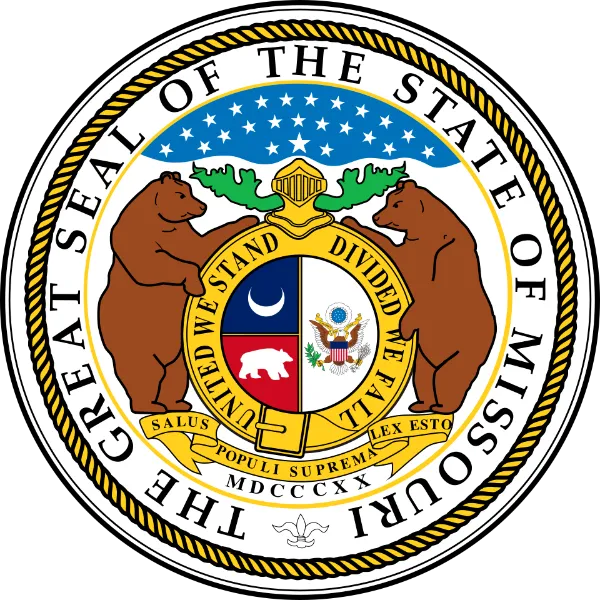
The motto appears on a scroll beneath two grizzly bears at the bottom of the state seal. The bears support a shield divided into two halves: the left side shows the U.S. coat of arms, and the right side shows a grizzly bear with a crescent moon above. Around the outer circle of the seal, another phrase reads United We Stand, Divided We Fall.
Above the shield, a crest features a bald eagle with 24 stars, representing Missouri as the 24th state. The outer ring reads: The Great Seal of the State of Missouri.
Missouri's state flag, officially approved in 1913, displays the state seal at center with the motto visible on the scroll beneath the bears.
Missouri State Motto Facts
- "Salus Populi Suprema Lex Esto" means "Let the Welfare of the People Be the Supreme Law."
- The phrase comes from Cicero's De Legibus (On Laws), Book III — written in the final years of the Roman Republic.
- Missouri dropped the word "ollis" from Cicero's original, turning a conditional instruction into a universal principle.
- The seal and motto were adopted on January 11, 1822 — about five months after Missouri became the 24th state on August 10, 1821.
- Judge Robert William Wells designed the state seal.
- The seal also carries a second phrase: "United We Stand, Divided We Fall," encircling the shield above the motto scroll.
Can You Match All 50 State Mottos?
Some questions show the original motto — Latin, Italian, Chinook — and ask which state it belongs to. Others give you the English translation and ask you to work backward. Both directions are harder than they look.
Take the State Mottos QuizQuick Answers
What is Missouri's state motto?
What does "Salus Populi Suprema Lex Esto" mean?
Where does Missouri's motto come from?
When did Missouri adopt its state motto?
Where does the motto appear?
Sources
Missouri State Symbols


Show more (2)


Related States


Compare all 50 states by population, land area, statehood date, and more.
Themed lists - states sharing the same bird, oldest symbols, flags with bears, and more.
Side-by-side comparison of population, area, income, taxes, climate, and more.
Top 20 most common surnames per state - with origins, meanings, and heritage context. Is yours on the list?
You Might Also Like

Serial Killers by State
Alaska has the highest serial killer rate at 0.867 per 100,000 residents. Hawaii is lowest, and California has the highest raw count at 128.

Flag of Arkansas
Arkansas had no state flag until 1913. Its white diamond marks the only diamond-producing state. A fourth star marks Confederate membership.

Flag of Arizona
Arizona's flag was sketched on an envelope in 1910 for a rifle team. Adopted in 1917, it became law without the governor's signature.

Flag of Alaska
Benny Benson designed Alaska's flag at 13. Eight gold stars on navy blue, the Big Dipper pointing to Polaris, adopted in 1927 and kept at statehood.

Alabama State Flag
Alabama's crimson cross on white was adopted in 1895, likely modeled after the Confederate Battle Flag. The state's first flag was destroyed by a storm one month after raising.

Flag of California
Brown grizzly on white, adopted in 1911, traces to settler William Todd's handmade flag raised at Sonoma on June 14, 1846.

Rainwater Harvesting Laws by State
Rainwater harvesting is legal in all 50 states. Colorado caps residential storage at 110 gallons, while Utah allows up to 2,500 gallons.

Weird Laws in Arkansas
Weird laws in Arkansas include a repealed statewide tattoo ban, a 145-year-old pronunciation law, and a Sunday car sales rule that is still enforced today.