Mississippi State Motto: Virtute et Armis
Virtute et Armis


Virtute et Armis
The motto appears on the state seal of Mississippi
- Motto
- Virtute et Armis
- Language
- Latin
- Translation
- By Valor and Arms
- Adopted
- 1894
Mississippi State Motto
Mississippi's state motto is Virtute et Armis, a Latin phrase meaning By Valor and Arms. It was adopted in 1894 through an extraordinary legislative session, 77 years after Mississippi became the 20th state on December 10, 1817.
The motto appears on the state coat of arms, not on the current state flag. Mississippi's flag, redesigned in 2021, displays the phrase In God We Trust instead.
Translation of "Virtute et Armis"
Virtute is the ablative case of virtus, meaning by valor or by courage. Et means and. Armis is the ablative of arma, meaning by arms or by weapons.
In Latin, the ablative case indicates the means of action. The full phrase means: achieving something by means of both valor and arms.
Mississippi State Motto Meaning
The Latin word virtus originally described the qualities of a good soldier: courage, strength, and excellence in battle. Over time it broadened to include moral character and personal worth, but its martial roots remained close to the surface.
Pairing virtus with arma (arms) makes the military reference direct. The motto combines inner courage with physical military strength as equal sources of achievement.
History of Mississippi's State Motto
Mississippi became the 20th state on December 10, 1817, but went 77 years without an official coat of arms. On February 7, 1894, the legislature appointed a committee to design one. Historical records link the motto to James Rhea Preston, the state superintendent of education, who proposed the Latin phrase for the red scroll in the coat of arms design.
An extraordinary legislative session in 1894 approved the coat of arms under Chapter 37 of the Laws of the Extraordinary Session. The same session also adopted a new state flag with a Confederate battle cross canton. Both decisions came from the same post-Reconstruction legislature.
In 1906, during a revision of the Mississippi Code, the coat of arms law was accidentally omitted. In May 2000, the Mississippi Supreme Court ruled that the state technically had no official coat of arms. Governor Ronnie Musgrove signed a new law on February 7, 2001, exactly 107 years after the original adoption, formally restoring the 1894 design. The motto and coat of arms are now codified in Mississippi Code § 3-3-41.
"Virtute et Armis" on the Mississippi State Coat of Arms
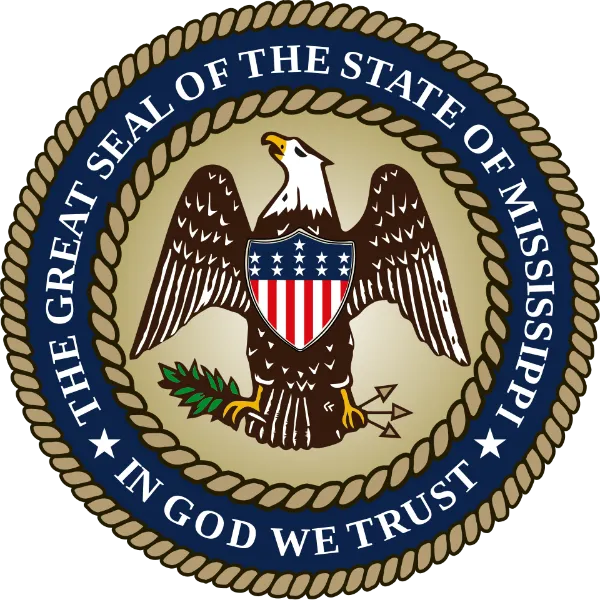
The motto appears in white letters on gold spaces along a red scroll at the bottom of the coat of arms. The shield above shows an eagle holding a palm branch in its right talon and a bundle of arrows in its left. Mississippi appears above the eagle in gold, and cotton stalks are arranged below the shield.
Mississippi's current state flag, adopted January 11, 2021, does not show the state motto. The flag features a white magnolia blossom, a ring of 20 white stars and one gold star, and the phrase In God We Trust. The coat of arms with the motto appears on official state documents and government publications.
Mississippi State Motto Facts
- Mississippi went 77 years after statehood before adopting a coat of arms and motto in 1894.
- "Virtute et Armis" means "By Valor and Arms" in Latin.
- Historical records link the motto to James Rhea Preston, the state superintendent of education.
- The 1894 coat of arms law was accidentally dropped from the 1906 Code revision. Governor Musgrove re-signed it on February 7, 2001.
- The motto appears on the red scroll of the coat of arms, not on the current state flag.
- Mississippi Code § 3-3-41 now codifies the coat of arms and motto.
Can You Match All 50 State Mottos?
Some questions show the original motto — Latin, Italian, Chinook — and ask which state it belongs to. Others give you the English translation and ask you to work backward. Both directions are harder than they look.
Take the State Mottos QuizQuick Answers
What is Mississippi's state motto?
What does "Virtute et Armis" mean?
When did Mississippi adopt its state motto?
Where does Mississippi's motto appear?
Did Mississippi's motto change when the flag changed in 2021?
Sources
- Mississippi Code § 3-3-41 — Coat of Arms
- Coat of Arms of Mississippi — Wikipedia
- Mississippi Secretary of State — State Symbol Sheet
Mississippi State Symbols


Show more (2)


Related States


Compare all 50 states by population, land area, statehood date, and more.
Themed lists - states sharing the same bird, oldest symbols, flags with bears, and more.
Side-by-side comparison of population, area, income, taxes, climate, and more.
Top 20 most common surnames per state - with origins, meanings, and heritage context. Is yours on the list?
You Might Also Like

Serial Killers by State
Alaska has the highest serial killer rate at 0.867 per 100,000 residents. Hawaii is lowest, and California has the highest raw count at 128.

Flag of Arkansas
Arkansas had no state flag until 1913. Its white diamond marks the only diamond-producing state. A fourth star marks Confederate membership.

Flag of Arizona
Arizona's flag was sketched on an envelope in 1910 for a rifle team. Adopted in 1917, it became law without the governor's signature.

Flag of Alaska
Benny Benson designed Alaska's flag at 13. Eight gold stars on navy blue, the Big Dipper pointing to Polaris, adopted in 1927 and kept at statehood.

Alabama State Flag
Alabama's crimson cross on white was adopted in 1895, likely modeled after the Confederate Battle Flag. The state's first flag was destroyed by a storm one month after raising.

Flag of California
Brown grizzly on white, adopted in 1911, traces to settler William Todd's handmade flag raised at Sonoma on June 14, 1846.

Rainwater Harvesting Laws by State
Rainwater harvesting is legal in all 50 states. Colorado caps residential storage at 110 gallons, while Utah allows up to 2,500 gallons.

Weird Laws in Arkansas
Weird laws in Arkansas include a repealed statewide tattoo ban, a 145-year-old pronunciation law, and a Sunday car sales rule that is still enforced today.