Michigan State Motto: Si Quaeris Peninsulam Amoenam Circumspice

US
Researched by USA Symbol Team

Fact-checked • Updated December 2, 2025

About Editor
Michigan State Seal

OFFICIAL STATE SEAL

Latin 1835

"Si Quaeris Peninsulam Amoenam Circumspice"

If you seek a pleasant peninsula, look about you

About This Motto

Michigan adopted Si Quaeris Peninsulam Amoenam Circumspice on June 2, 1835. Latin phrase translates to If you seek a pleasant peninsula, look about you. Constitutional Convention adopted motto as part of Great Seal. Lewis Cass designed seal while serving as territorial governor. Michigan became 26th state January 26, 1837.

What the Motto Means

Si Quaeris Peninsulam Amoenam Circumspice translates to If you seek a pleasant peninsula, look about you. Latin phrase invites observers to appreciate Michigan's geography. Two peninsulas define state's shape. Upper and Lower Peninsulas surrounded by Great Lakes. Motto celebrates natural beauty and unique location.

Why this phrase? Lewis Cass drew inspiration from Christopher Wren's epitaph at St. Paul's Cathedral in London. Wren's monument reads: Si monumentum requiris, circumspice. Translation: If you seek his monument, look around you. Cass adapted phrase to highlight Michigan's landscape instead of architectural achievement. Substituted peninsulam amoenam (pleasant peninsula) for monumentum (monument).

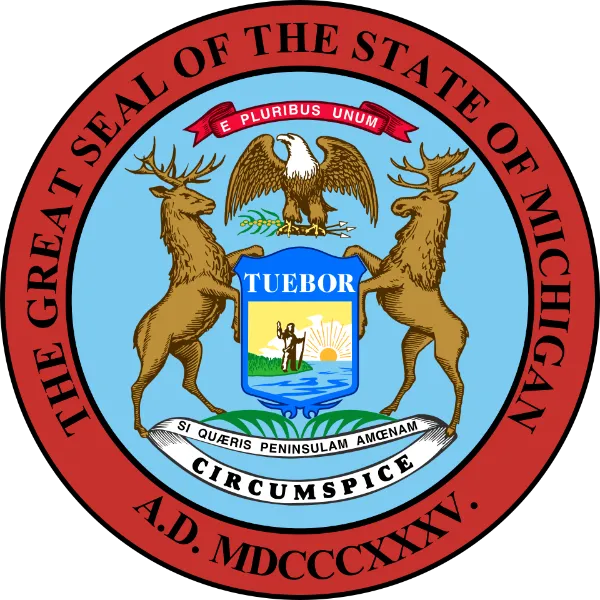
Constitutional Convention of 1835 met in May. Delegates drafted Michigan's first state constitution. Territory sought admission to Union. Lewis Cass presented his seal design to convention. Motto appeared on white ribbon curving below shield. Design featured man standing on peninsula beside lake. Sun rising over water. Elk and moose supporting shield. American eagle above holding arrows and olive branch.

Motto splits across two ribbons on seal. Upper ribbon shows: Si quaeris peninsulam, amoenam. Lower ribbon completes phrase: circumspice. Three Latin mottos total appear on seal. E Pluribus Unum curves above eagle. Tuebor (I will defend) arcs above shield. State motto completes design below.

Historical Background

  1. Michigan Territory Created

    Michigan Territory organized June 30, 1805 when President Thomas Jefferson signed the law creating a separate territory. Previously part of the Northwest Territory established in 1787, it used Detroit as territorial capital. The territory included present-day Michigan plus portions of Wisconsin and Minnesota. Lewis Cass received appointment as territorial governor in 1813, serving until 1831, a total of 18 years.

  2. Lewis Cass Designed Seal

    Lewis Cass created the Great Seal design during his territorial governorship. Born in 1782 in New Hampshire, he moved to the Ohio frontier as a young man and studied law in Marietta. After serving in the War of 1812 as colonel, he was appointed Michigan territorial governor in 1813 at age 31. His deep knowledge of Michigan geography came from negotiating treaties with Native American tribes and exploring Upper Peninsula regions. These travels informed the seal design showing a man on a peninsula.

  3. Hudson Bay Fur Company Inspiration

    Cass patterned the seal after Hudson Bay Fur Company emblem, a British trading enterprise established in 1670. The company seal featured frontier imagery showing landscapes and native animals, emphasizing natural bounty and commerce. Cass adapted similar elements for Michigan, including elk and moose as supporters while featuring peninsula and lake prominently. His design highlighted Michigan's fur trading heritage, since the territory's economy depended heavily on fur trade during the early 1800s.

  4. Constitutional Convention May 1835

    Territory called Constitutional Convention in May 1835 as Governor Stevens T. Mason pushed for statehood. Michigan population exceeded 60,000 residents, meeting the Northwest Ordinance requirement for statehood eligibility. Despite lacking Congressional approval, the convention met and delegates drafted the state constitution in 45 days. Lewis Cass presented his Great Seal design, which the convention adopted on June 2, 1835 as the official emblem for the prospective state.

  5. Toledo War Controversy

    Michigan statehood blocked by boundary dispute with Ohio. The conflict, called Toledo War (1835-1836), centered on the Toledo Strip, a narrow band of land 468 square miles. It included the city of Toledo and Maumee River mouth. Both Michigan and Ohio claimed the territory. Northwest Ordinance of 1787 used inaccurate maps, leading surveyors to draw two different boundary lines. Ohio insisted on the northern line while Michigan claimed the southern line placed Toledo in its territory.

  6. Border Conflict Details

    Ohio Governor Robert Lucas established Lucas County in the disputed strip, prompting Michigan to pass the Pains and Penalties Act in response, which made it a crime for Ohio officials to exercise jurisdiction. Stevens T. Mason led the Michigan militia to the Toledo area, resulting in a minor skirmish at Phillips Corners on April 26, 1835 where a Michigan deputy was stabbed with a pen knife. This was the only violence of the entire war, with no deaths occurring. President Andrew Jackson intervened, removed Mason from office temporarily, and pushed for a compromise solution.

  7. Compromise Reached December 1836

    Congress proposed compromise June 15, 1836. Michigan would cede Toledo Strip to Ohio. Receive western three-quarters of Upper Peninsula in exchange. First convention in September rejected deal. Delegates viewed Upper Peninsula as worthless wilderness. Second convention called December 14, 1836. Frostbitten Convention accepted compromise. Michigan faced bankruptcy without statehood. Territory needed federal recognition for financial stability.

  8. Statehood Achieved January 26, 1837

    President Jackson signed the Michigan statehood law, admitting Michigan to the Union on January 26, 1837 as the 26th state. Michigan lost the Toledo Strip but gained the Upper Peninsula in what initially seemed a poor trade-off. The Upper Peninsula contained 9,000 square miles considered good only for timber and fur. However, copper was discovered in Keweenaw Peninsula in the 1840s, followed by iron ore in the Central Upper Peninsula the same decade. The mining boom transformed the region, and Michigan's mineral wealth exceeded Toledo's value many times over.

  9. Flag Adoption 1865

    Michigan coat of arms appeared on various flags from 1837 onward, but no official state flag existed until 1865 when Adjutant-General John Robertson recommended a design that Governor Henry Crapo approved. The flag showed the state coat of arms on a blue field with the reverse side displaying United States arms. It was first unfurled on July 4, 1865 at the Gettysburg corner stone ceremony for the Soldiers' National Cemetery monument. The legislature standardized the flag design in 1911 with a simple statute stating: State Flag shall be blue charged with the arms of the state.

Meaning & Significance Today

Motto appears on state seal and flag. Michigan flag shows coat of arms centered on blue field. Great Seal surrounds design with text. Words read: The Great Seal of the State of Michigan A.D. MDCCCXXXV. Roman numerals indicate 1835. Motto curves on white ribbons below shield. State police cars display seal. Official documents bear impression. Driver licenses include seal design.

Two peninsulas define Michigan's identity. Lower Peninsula shaped like mitten. Upper Peninsula borders Wisconsin. Four Great Lakes surround state. Michigan has 3,288 miles of Great Lakes shoreline. More than any other state. Geography makes motto eternally relevant. Visitors and residents observe natural beauty everywhere. Motto invitation remains accurate 190 years after adoption.

Upper Peninsula trade-off proved fortunate. Copper mining boomed starting 1840s. Keweenaw Peninsula produced massive copper deposits. Iron ore mining followed in 1850s. Marquette Iron Range became major source. Timber industry harvested vast forests. Natural resources drove Michigan economy through early 1900s. Toledo Strip would have provided one port city. Upper Peninsula provided century of mineral wealth. Modern Michiganders view compromise as victory.

Lewis Cass had long distinguished career after territorial governorship. Served as U.S. Secretary of War 1831-1836 under Andrew Jackson. Elected U.S. Senator from Michigan 1845-1848 and 1849-1857. Ran for president 1848 as Democratic candidate. Lost to Zachary Taylor. Appointed Secretary of State 1857-1860 under James Buchanan. Resigned over slavery disagreement. Died 1866 at age 83. Cass County and city of Cassopolis named for him. His seal design remained Michigan's emblem throughout his lifetime and beyond.

Cultural Context in Michigan

1835 Frontier Michigan

Michigan Territory remained frontier region in 1835. Detroit largest settlement with 4,000 residents. Most territory sparsely populated. Fur trade dominated economy. Native American tribes controlled much territory. Treaties gradually ceded land to federal government. Treaty of Saginaw 1819 opened central Michigan. Treaties of Chicago 1821 and 1833 acquired more land. Settlers arrived from New York and New England. Erie Canal opened 1825 made travel easier.

Great Lakes Geography

Four Great Lakes border Michigan. Lake Superior to north. Lake Michigan to west. Lake Huron to east. Lake Erie to southeast. No other state touches four Great Lakes. Water defines state boundaries. Peninsulas created by glacial activity. Lower Peninsula between Lakes Michigan and Huron. Upper Peninsula between Lakes Superior and Michigan. Geography made motto obvious choice. Latin phrase described physical reality visible to anyone.

Seal Design Elements

Man on peninsula holds rifle but raises hand in peace. Gesture shows readiness to defend while preferring peace. Sun rises over water suggesting enlightenment and new beginning. Lake likely meant to show Lake Michigan. Elk and moose serve as supporters. Both species native to Michigan forests. American eagle appears in crest above shield. Holds olive branch with 13 olives. Other talon grips three arrows. Design combines state and national imagery.

Christopher Wren's Legacy

Wren lived 1632-1723. Trained as astronomer and mathematician. Became architect after London's Great Fire 1666. Rebuilt St. Paul's Cathedral and 51 other London churches. Founded Royal Society. Served as president 1680-1682. Knighted 1673. His epitaph became famous example of understated memorial. Simple phrase pointed to massive architectural achievement. Cass recognized parallel. Michigan's peninsulas served as natural monument. No elaborate description needed. Invitation to look sufficed.

Rival State Mottos Comparison

Most state mottos emphasize values or principles. New York: Excelsior (Ever upward). Virginia: Sic semper tyrannis (Thus always to tyrants). Kansas: Ad astra per aspera (To the stars through difficulties). Michigan chose different approach. Motto describes geography rather than aspiration. Celebrates natural features instead of political ideals. Only four states focus on geography in mottos. Makes Michigan's choice distinctive among 50 states.

Statehood Timing

Michigan entered Union during Jacksonian Era. Andrew Jackson presidency emphasized expansion and democracy. Michigan became 26th state. Admitted as free state under Northwest Ordinance. Slavery prohibited in territory. Arkansas admitted as slave state same month. June 1836 admission of Arkansas as slave state balanced Michigan's free state status. Political compromise maintained sectional balance. Michigan's admission preceded Civil War by 24 years. State supplied 90,000 troops to Union during war.

Current Law

Michigan Compiled Laws govern Great Seal. Statute describes coat of arms elements. Blue shield shows sun rising over lake. Peninsula appears with man standing on it. Man dressed in rustic clothing. Right arm raised in peace. Left arm holds rifle. Five-pointed silver star in upper left corner. Star placed next to figure's head. Indicates Michigan as one of original states from Northwest Territory.

Crest features American eagle on wreath of blue and gold. Eagle rises toward right. Wing tips partly lowered. Right talon holds olive branch with 13 fruit. Left talon grips sheaf of three arrows. Red scroll above eagle displays E Pluribus Unum. National motto means Out of many, one. Shield bears Tuebor at top. Word means I will defend. References Michigan's frontier position.

Elk stands at right as supporter. Moose stands at left. Both animals rear on hind legs. Upper white ribbon displays: Si quaeris peninsulam, amoenam. Lower white ribbon shows: circumspice. Complete phrase forms state motto. Text appears in black letters on white ribbons. Official dies of Great Seal remain at Secretary of State office. Cannot be transported outside Michigan. Used only for specific official documents including extraditions, pardons, gubernatorial appointments.

Interesting Facts About the Motto

Fact 1 of 16

Lewis Cass adapted the motto from Christopher Wren's epitaph at St. Paul's Cathedral in London.

Sources & References

This article has been researched using authoritative sources to ensure accuracy and reliability. All information has been fact-checked and verified against official government records.

1
Wikipedia - Seal of Michigan
https://en.wikipedia.org/wiki/Seal_of_Michigan

Comprehensive history of Michigan's Great Seal, Lewis Cass's design, and adoption at 1835 Constitutional Convention. • Accessed: December 31, 2025

2
Michigan.gov - History of the Great Seal
https://www.michigan.gov/sos/Notary-services/great-seal/history-of-the-great-seal-and-coat-of-arms

Official state documentation of seal design, Hudson Bay Company inspiration, and coat of arms elements. • Accessed: December 31, 2025

3
NetState - Michigan State Motto
https://www.netstate.com/states/mottoes/mi_motto.htm

Detailed breakdown of motto translation, legal status, and current Michigan statute description. • Accessed: December 31, 2025

4
Wikipedia - Toledo War
https://en.wikipedia.org/wiki/Toledo_War

Complete history of 1835-1836 boundary dispute between Michigan and Ohio that delayed statehood. • Accessed: December 31, 2025

5
Michigan.gov - State Facts and Symbols
https://www.michigan.gov/som/about-michigan/state-facts-and-symbols

Official state information including motto translation, seal design by Lewis Cass, and statehood date. • Accessed: December 31, 2025

Accuracy Commitment: We strive to maintain accurate and up-to-date information. If you notice any errors or outdated information, please contact us.

Other Michigan Symbols

People Also Ask

What is Michigan's state motto?
Michigan's motto is 'Si Quaeris Peninsulam Amoenam Circumspice,' which translates to 'If you seek a pleasant peninsula, look about you.'
When did Michigan adopt this motto?
The motto was adopted on June 2, 1835, by the Constitutional Convention as part of the Great Seal design.
Who designed Michigan's Great Seal with the motto?
Lewis Cass, Michigan's second territorial governor, designed the seal while serving from 1813 to 1831.
What does 'Si Quaeris Peninsulam Amoenam Circumspice' mean?
It means 'If you seek a pleasant peninsula, look about you' in Latin, inviting people to observe Michigan's natural beauty.
Where did the motto come from?
Lewis Cass adapted it from Christopher Wren's epitaph at St. Paul's Cathedral in London, which reads 'Si monumentum requiris, circumspice.'
When did Michigan become a state?
Michigan became the 26th state on January 26, 1837, nearly two years after adopting the motto.
What was the Toledo War?
The Toledo War (1835-1836) was a boundary dispute between Michigan and Ohio over the Toledo Strip that delayed Michigan's statehood.
Did Michigan win or lose the Toledo War?
Michigan ceded the Toledo Strip to Ohio but received the Upper Peninsula, which proved far more valuable due to copper and iron deposits.
Who was Christopher Wren?
Christopher Wren (1632-1723) was the English architect who designed St. Paul's Cathedral in London and 51 other churches.
Where does the motto appear today?
The motto appears on Michigan's state seal, state flag, official documents, state police cars, and driver's licenses.
How many Latin mottos appear on Michigan's seal?
Three Latin mottos appear: 'E Pluribus Unum' (national motto), 'Tuebor' (I will defend), and the state motto.
What inspired Lewis Cass to design the seal?
Cass patterned the seal after the Hudson Bay Fur Company emblem, adapting frontier imagery to Michigan's geography and fur trading heritage.