Iowa State Motto: Our Liberties We Prize And Our Rights We Will Maintain
Our Liberties We Prize And Our Rights We Will Maintain


Our Liberties We Prize And Our Rights We Will Maintain
The motto appears on the state seal of Iowa
- Motto
- Our Liberties We Prize And Our Rights We Will Maintain
- Language
- English
- Adopted
- 1847
- Distinction
- Longest state motto in the United States
- Appears on
- State seal and state flag
- Legislation
- Iowa Code § 1.8
Iowa State Motto
Iowa's state motto is Our Liberties We Prize And Our Rights We Will Maintain. The first Iowa General Assembly adopted it in 1847, just 58 days after Iowa achieved statehood. At 53 characters, it is the longest state motto in the United States.
The motto appears on the Great Seal of Iowa, carried on a scroll by the bald eagle at the top of the seal's design. It also appears on the Iowa state flag, designed by Dixie Cornell Gebhardt in 1921. Iowa is one of the few states whose motto is clearly visible on both the seal and the flag.
Iowa State Motto Meaning
The motto divides into two parallel statements joined by And. The first half — Our Liberties We Prize — is a declaration of value: Iowa's citizens hold their civil liberties dear. The second half — Our Rights We Will Maintain — is a declaration of commitment: those rights will be defended. Prize and Maintain are carefully chosen words. To prize something is to hold it in high regard; to maintain it is to actively keep it intact.
The phrase is written in the first person plural. It is not a statement about abstract ideals or distant government. It is a statement from the people of Iowa about what they themselves value and intend to protect. For a state founded on the frontier in 1846, that directness was deliberate.
The word rights carried specific weight in 1847. Iowa entered the Union as a free state, and the question of what rights citizens could claim and defend was central to American political life in the years leading to the Civil War. The motto's language is assertive rather than decorative.
History of Iowa's State Motto
Iowa was organized as a territory in 1838 and admitted to the Union as the 29th state on December 28, 1846. The first Iowa General Assembly met shortly after statehood and moved quickly to establish the instruments of state government. The state seal — and the motto placed on it — were adopted 58 days after Iowa became a state.
The motto was not adopted separately from the seal. It was written into the seal's design from the beginning, carried on a scroll held by the bald eagle at the top of the composition. Iowa Code § 1.8 has governed the seal and the motto's official form since the 19th century.
In 1921, when Dixie Cornell Gebhardt designed the Iowa state flag, she drew the central imagery directly from the seal: a bald eagle carrying a blue scroll with the state motto. The flag design brought the full text of the motto into a widely flown state symbol, making Iowa's unusually long motto one of the most visible in the country.
"Our Liberties We Prize" on the Iowa State Seal
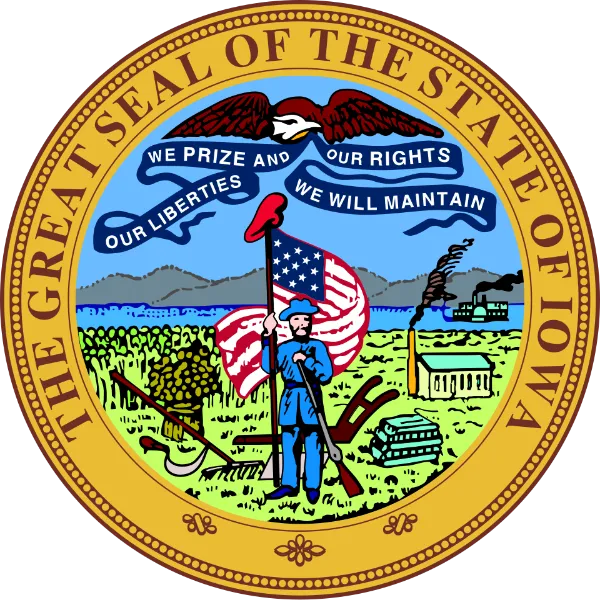
The motto appears on a scroll held by the bald eagle at the top of the Great Seal of Iowa. Below the eagle, the seal shows a citizen soldier holding a U.S. flag and a rifle, surrounded by farming tools, fields, and a river landscape with a steamboat. The scroll with the motto is the most visually prominent text element of the seal.
The Iowa state flag carries the motto as well. Dixie Cornell Gebhardt's 1921 design places a bald eagle at the center of the flag's white stripe, with a blue scroll beneath it reading the full state motto. The flag has been in use ever since, making the motto a fixture of Iowa's public buildings, courthouses, and official spaces.
Iowa State Motto Facts
- "Our Liberties We Prize And Our Rights We Will Maintain" is the longest state motto in the United States at 53 characters.
- Iowa adopted the motto 58 days after becoming the 29th state on December 28, 1846.
- The motto appears on a scroll carried by the bald eagle on the Great Seal of Iowa.
- The Iowa state flag, designed by Dixie Cornell Gebhardt in 1921, also displays the full motto on a blue scroll beneath the eagle.
- Iowa Code § 1.8 governs the Great Seal, including the motto's official text and placement.
- Iowa had no state motto before 1847 — the first General Assembly adopted it alongside the seal in Iowa's first year of statehood.
Can You Match All 50 State Mottos?
Some questions show the original motto — Latin, Italian, Chinook — and ask which state it belongs to. Others give you the English translation and ask you to work backward. Both directions are harder than they look.
Take the State Mottos QuizQuick Answers
What is Iowa's state motto?
What does Iowa's state motto mean?
Why is Iowa's state motto the longest in the U.S.?
When did Iowa adopt its state motto?
Where does Iowa's motto appear?
Sources
- Iowa Legislature — Iowa Code § 1.8
- Iowa State Historical Society
- Iowa Secretary of State — State Symbols
Iowa State Symbols


Show more (2)


Related States


Compare all 50 states by population, land area, statehood date, and more.
Themed lists - states sharing the same bird, oldest symbols, flags with bears, and more.
Side-by-side comparison of population, area, income, taxes, climate, and more.
Top 20 most common surnames per state - with origins, meanings, and heritage context. Is yours on the list?
You Might Also Like

Serial Killers by State
Alaska has the highest serial killer rate at 0.867 per 100,000 residents. Hawaii is lowest, and California has the highest raw count at 128.

Flag of Arkansas
Arkansas had no state flag until 1913. Its white diamond marks the only diamond-producing state. A fourth star marks Confederate membership.

Flag of Arizona
Arizona's flag was sketched on an envelope in 1910 for a rifle team. Adopted in 1917, it became law without the governor's signature.

Flag of Alaska
Benny Benson designed Alaska's flag at 13. Eight gold stars on navy blue, the Big Dipper pointing to Polaris, adopted in 1927 and kept at statehood.

Alabama State Flag
Alabama's crimson cross on white was adopted in 1895, likely modeled after the Confederate Battle Flag. The state's first flag was destroyed by a storm one month after raising.

Flag of California
Brown grizzly on white, adopted in 1911, traces to settler William Todd's handmade flag raised at Sonoma on June 14, 1846.

Rainwater Harvesting Laws by State
Rainwater harvesting is legal in all 50 states. Colorado caps residential storage at 110 gallons, while Utah allows up to 2,500 gallons.

Weird Laws in Arkansas
Weird laws in Arkansas include a repealed statewide tattoo ban, a 145-year-old pronunciation law, and a Sunday car sales rule that is still enforced today.